For well over a decade, Unity has been one of, if not the primary engine for indie game development, and has powered some massively successful games like Hollow Knight, Among Us, and the original Subnautica. But over the last few years, a growing number of developers have switched to Godot, an open-source engine that is similar to Unity in its scope and functionality.
For those developers who have switched, the reasons have often been ethical or financial, with various shenanigans from Unity putting developers off using the company’s tech. But placing that aside, how do the two engines compare as tools? One game developer decided to find out, by making exactly the same game in both engines.
That designer is Thomas Grové, who runs the Japanese co-production developer Studio Interrupt. Grové was making a survival horror game with his son, and decided to use the project to test out both engines.
“For a long time, I’ve really wanted to see a side-by-side, apples-to-apples comparison between the two engines, not like the same game made by different developers or whatever,” Grové says in a YouTube video discussing the experiment (via Automaton). “I thought this was my chance to finally do that and decide whether I want to move forward with Godot or keep using Unity.”
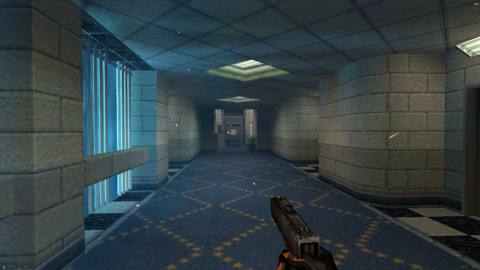
Grové starts out by listing the features of his game, which is clearly at a very early stage of development. Said features include a complete character controller, a camera transition system, a scene-transition system, a tri-planar dither shader and an interactable object system. He built and ran this game with all these features in both engines, before comparing how each engine fared during the project.
The results were intriguing. From a functionality perspective, Grové explained that the engines performed similarly, with each doing some minor things slightly better or worse than the other. However, he concluded that Godot was significantly more efficient in areas like compiling, launching, loading etc.
He notes that Godot is over five times faster at loading a project, 20 times faster at exporting a project, and a whopping 31 times faster at compiling a script, which could make a big difference considering you would perform some of these tasks hundreds of times when designing a game. On top of that, Godot is also a significantly smaller program in terms of file size, taking up just 164 megabytes compared to Unity’s 20 gigabytes.
Ultimately, Grové says that “If we look at all the data, Godot beat Unity on every metric except for the final output FPS”, with both exported projects running at a max framerate way about Grove’s minimum of 60FPS anyway. As such, he concludes that “I’m probably going to continue using Godot for this project.”
While this seems like a slam dunk for Godot, some of Grove’s viewers point out that the experiment may not be entirely reflective of each engine’s performance. “The scene was just too simple to stress any systems, as evidenced by the very high framerate,” writes YouTube user WitchfellGame, while the startlingly named jakegenocide says “If you aren’t using a full, complete, game project, you aren’t going to know which one is right for your project once it scales up.”
Building two entire games from scratch just to test the performance of game engines isn’t especially viable, however. And while maybe you could stress test further, the consistency and scale of difference in Grové’s results do suggest that, broadly, Godot is the more efficient engine of the two.

2026 games: All the upcoming games
Best PC games: Our all-time favorites
Free PC games: Freebie fest
Best FPS games: Finest gunplay
Best RPGs: Grand adventures
Best co-op games: Better together
About Author