We often talk about Doom—the original 1993 shooter from the young upstarts at id Software—as one of the most influential videogames of all time. But the Washington Post, one of the country’s most highly-regarded papers of record, has elevated it to an even higher plateau: It has selected Doom as one of the 25 most influential works of American culture, representing the absolute pinnacle of its era.
The list, assembled to commemorate the 250th anniversary of the United States of America, covers a remarkable breadth, from Thomas Paine’s Common Sense to the Star Spangled Banner, Narrative of the Life of Frederick Douglass, an American Slave, the Battle Hymn of the Republic, Levi’s jeans, Mickey Mouse, and the recordings of legendary blues man Robert Johnson: One selection marking the highlight of each decade of America’s existence, bolstered by a handful of honorable mentions.
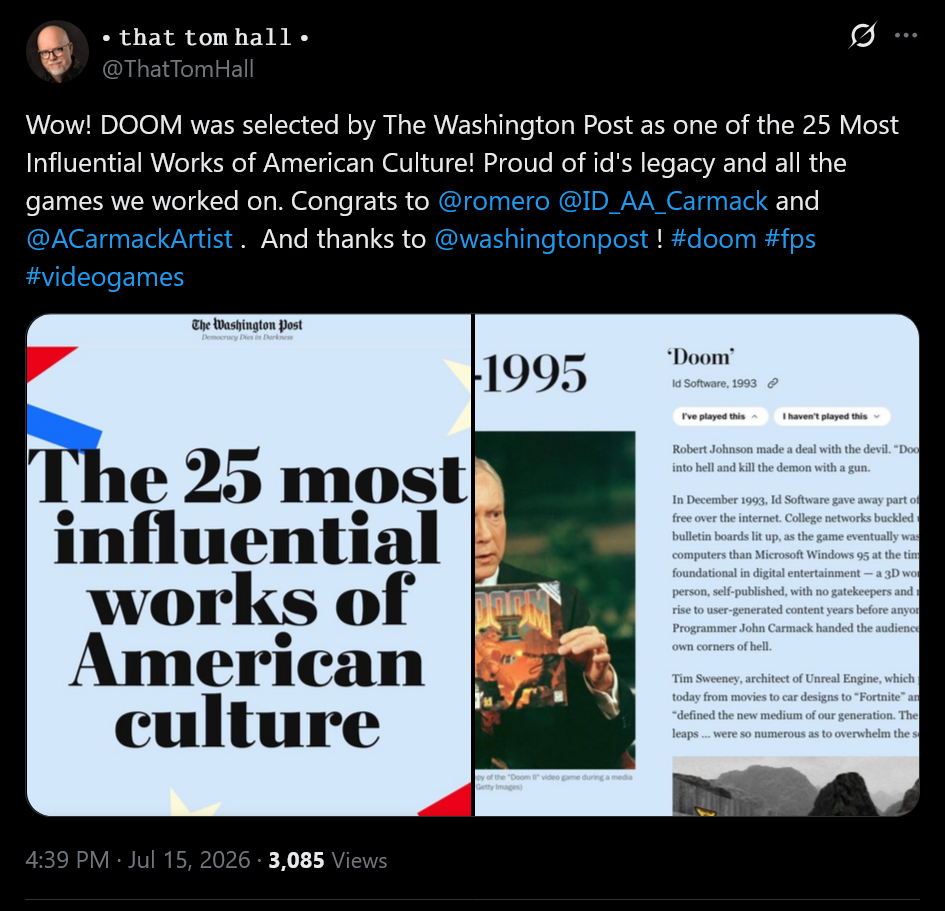
And there, for the decade of 1986-1995, is Doom—beating out heavyweight competition including Amy Tan’s The Joy Luck Club, Spike Lee’s Do the Right Thing, The Simpsons, Seinfeld, and the MTV reality series The Real World.
“In December 1993, Id Software gave away part of its new videogame free over the internet. College networks buckled under the traffic, and bulletin boards lit up, as the game eventually was installed on more computers than Microsoft Windows 95 at the time,” Washington Post videogame critic Gene Park wrote.
“Doom was foundational in digital entertainment—a 3D world viewed in first person, self-published, with no gatekeepers and no retail store, as it gave rise to user-generated content years before anyone had a name for it. Programmer John Carmack handed the audience the tools to build their own corners of hell.”
Park acknowledged the negative perceptions of Doom over the years in his ode to the game’s impact, saying it “was a scapegoat for the 1999 Columbine High School shooting in Colorado, ground zero of America’s ongoing nightmare.” But, he added, “It was people with guns, not a game, that took lives. A grieving nation feared a new form of entertainment it misunderstood. Hearings were held on games and music, a template that would replay after nearly every mass shooting since.”
Ultimately, in Park’s view, Doom embodies America: “The game’s spirit of sharing and community, along with its pioneering approach to guiding players through abstract environments in 3D space, is rooted in the upbringing of designer John Romero, who is Native American (Yaqui, Cherokee) and Mexican.”
Quoting Romero, Park continued, “‘A lot of Doom’s design, especially the level design, was really influenced by just that understanding of the environment, the world, and that comes from my dad, my grandma, everybody’— generations, he says, ‘where people lived on the land’ they believed to be shared.”
Romero himself seemed pretty excited about it:

So was his fellow id co-founder Tom Hall:
It’s a reflection of the way we perceive time and history, but more recent entries in the list definitely feel more like pop culture fluff than culturally significant works: Keeping Up with the Kardashians was selected for the 2006-2015 decade, for instance. But the Post says it’s not meant to be a “best of” list, but rather a series of historical signposts, each defining its time.
“No decade can be summed up any more than a country can be summed up, but if we wrote an autobiography not of words but of works—books, music and art, ideas, dress and culture—these 25 would be among the most momentous,” the Post’s culture critic Philip Kennicott wrote. “These are not necessarily our proudest moments, but they are defining acts of culture. It is an imperfect list, and incomplete, but then that is America, imperfect and unfinished.”
This is the second time Doom has been recognized as a culturally important American work in recent months. In May the Doom soundtrack was added to the country’s “national playlist” in the US Library of Congress.
2026 games: All the upcoming games
Best PC games: Our all-time favorites
Free PC games: Freebie fest
Best FPS games: Finest gunplay
Best RPGs: Grand adventures
Best co-op games: Better together
About Author