I’m a thoroughly average gamer. And in first-person shooters, I reckon I am ever so slightly above average at aiming—If aim-tester software, Aimlabs, is anything to go by, at least (top 38%, baby). But as a hardware tester, I have access to all kinds of gaming gear, and that includes competitive-level specs.
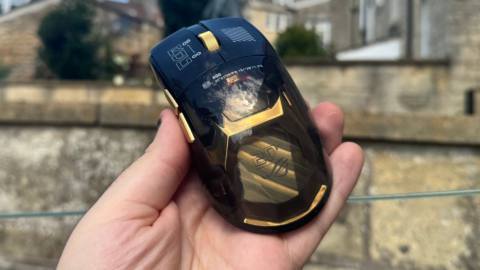
I wanted to see if the average gamer would benefit from a better polling rate and, as the average gamer, I thought I was the perfect guinea pig. So, grabbing my Asus Rog Harpe II Extreme Edition 20, a mouse with a max DPI of 65,000 and a max polling rate of 8,000 Hz, I went through the training software at different polling rates multiple times to see if it would improve my aim.
If you are unaware of what exactly a polling rate is, it is the rate at which your gaming mouse communicates with your rig. A 125 Hz polling rate gives feedback to your PC every 8 milliseconds, whereas 8,000 Hz gives feedback every 0.125 milliseconds. Generally speaking, the advice for most gamers is to linger at around 1,000 Hz, as responding every millisecond is plenty fast but not so fast that it drains the battery life of your squeaker.
Aimlabs is a free bit of software that tests your shooting across a series of firing ranges. It then ranks your accuracy and speed before putting it all together for a final score. A flat score of 50,000 tends to put you just around the middle of the pack worldwide. Considering this sample set consists of people who specifically seek out software to get better at shooting, I’d imagine the top 50% of Aimlabs is better at aiming than the top 50% of gamers overall.
First, my methodology. I booted up the Aimlabs software and picked Gridshot (Ultimate), a firing range where blue orbs pop up on screen, and you have to fire at them with a pistol. You have unlimited ammo, so you don’t have to concern yourself with conserving it, and you don’t need to move, either. Through minor adjustments and flicks, you simply have to hit the bubbles as quickly as you can whilst receiving score penalties for missing. That means it’s a test of both accuracy and speed. I went through the map at every polling rate once or twice (between seven and fourteen runs), before doing a final run, and those scores are the ones you see below.
After those warm-up rounds, I decided my first test would be on 1600 DPI, which is what feels most natural for me. You can see my results below
125 Hz | 58,612 |
250 Hz | 51,065 |
500 Hz | 57,027 |
1,000 Hz | 57,232 |
2,000 Hz | 53,244 |
4,000 Hz | 52,215 |
8,000 Hz | 58,441 |
Uhhh yeah, that is all over the place. But I can say it felt most comfortable at 1,000 Hz, mostly because I aim based on feel. I don’t usually pay all that much attention to the cursor as it moves. As such, I would say 125 Hz feels awkward but played fine, and 2,000 Hz is where I stop noticing much of a difference.
4000 DPI felt significantly worse, but it was where I noticed the polling rate making the biggest difference. I consistently lost track of the cursor at 125 Hz thanks to the speed of the mouse, but could fairly confidently read the position of the mouse at 8,000 Hz. You can see my results for that below
125 Hz | 37,885 |
250 Hz | 41,183 |
500 Hz | 43689 |
1,000 Hz | 48341 |
2,000 Hz | 46242 |
4,000 Hz | 50,053 |
8,000 Hz | 49,952 |
As you can see, the lower polling rate equates to lower scores at 4,000 DPI, but it varies a good bit past 1,000 Hz. My best score is at 4,000 Hz, but 8,000 Hz and 1000 Hz are close enough in score for me to say I don’t think I’m better at significantly higher polling rates. I did feel the difference all the way up to 4,000 Hz, though.
However, many pro players use a low DPI, ranging from 600 to 800 DPI, so I thought I’d test that and got by far my best scores
125 Hz | 57874 |
250 Hz | 58,879 |
500 Hz | 59,866 |
1,000 Hz | 60,256 |
2,000 Hz | 55041 |
4,000 Hz | 58,700 |
8,000 Hz | 56,170 |
Who knew that the pro players who spend multiple hours a day firing digital guns would be right about the best settings to fire those fake firearms? For me, I find 1,000 Hz is my sweet spot for performance and feel. Considering a slower DPI got me better scores, 800 DPI will become part of my regular rotation too. I’m a tad too impatient for lower than 1600 DPI whilst scrolling my desktop (especially with two monitors), but when it comes to aim, slower can be better. Or it can if you’re about average like me.
For ‘fun’, I tried it on the highest DPI I have available to me, 65000. I got a miserable score of 10,294, and even that was a huge struggle. So there you go. If you’re average at shooting (sorry to hear that), consider giving a low DPI a go. It might not feel as snappy, but it’s plenty quick after some getting used to and accurate to boot.
About Author