
The European Commission has opened an antitrust investigation into Google and whether it is imposing unfair terms on content creators and web publishers to power its AI services.
The Commission’s investigation focuses on two major concerns. First, the possible use of videos uploaded to YouTube being used to train generative AI models. This being done without the content creator receiving any money or being able to refuse to have their content used this way.
“Content creators uploading videos on YouTube have an obligation to grant Google permission to use their data for different purposes, including for training generative AI models,” the Commission says. “Google does not remunerate YouTube content creators for their content, nor does allow them to upload their content on YouTube without allowing Google to use such data.”
Secondly, the use of web publishers’ content (i.e. webpages) to provide AI Overviews and AI Mode.
“The Commission will investigate to what extent the generation of AI Overviews and AI Mode by Google is based on web publishers’ content without appropriate compensation for that, and without the possibility for publishers to refuse without losing access to Google Search.”
If you’re not familiar, AI Mode is more of a traditional chatbot interface for Google Search, while AI Overviews are the short summaries that appear at the top of a Google Search result in response to some search queries. These overviews use information provided by web publishers and content creators to offer an answer on Google’s platform to the user’s query. Thus, the user no longer needs to bother visiting the website that provided the information.
According to a Pew Research report, users that do not see an AI summary are almost twice as likely to visit a traditional search result link than those that do. A study by Authoritas found that websites that were ranked the highest for certain queries were losing around 79% of their traffic when an AI Overview was served on the results page.
AI Overviews are not present on all Google searches, and in fact, most estimations put them at under 50%. Google also disputes the Authoritas study. The company has previously defended AI Overviews and suggests it has not seen a dramatic drop in aggregate web traffic as a result of their rollout.
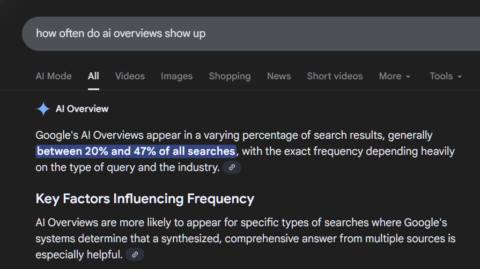
So, the way it’s shaping up, this antitrust case is going to get right back into the bitter argument between rightsholders, publishers, and big tech firms over AI.
As it stands, there’s an opt-out from EU copyright law for text and data mining, the so-called TDM (Text and Data Mining) Exception. This applies to the use of copyrighted material in training AI. However, the rightsholder retains the right to opt out of TDM.
“Directive (EU) 2019/790 introduced exceptions and limitations allowing reproductions and extractions of works or other subject matter, for the purpose of text and data mining, under certain conditions,” notes a recital on the EU Artificial Intelligence Act website.
“Under these rules, rightsholders may choose to reserve their rights over their works or other subject matter to prevent text and data mining, unless this is done for the purposes of scientific research. Where the rights to opt out has been expressly reserved in an appropriate manner, providers of general-purpose AI models need to obtain an authorisation from rightsholders if they want to carry out text and data mining over such works.”
So, effectively, the Commission is looking into two cases where, as it notes, there may be no way to opt out. Though there is another angle to all this: whether Google, by owning YouTube and Google Search, has an advantage over rival AI firms.
“AI is bringing remarkable innovation and many benefits for people and businesses across Europe, but this progress cannot come at the expense of the principles at the heart of our societies,” Teresa Ribera, executive vice president for clean, just and competitive transition, European Commission, says. “This is why we are investigating whether Google may have imposed unfair terms and conditions on publishers and content creators, while placing rival AI models developers at a disadvantage, in breach of EU competition rules.”
The investigation has begun “as a matter of priority” but there’s no set limit to how long it might go on for, so we’ll have to sit and wait patiently for the decision to come through. In the past, the Commission has handed out many fines to big tech companies over breaching EU rules, most recently with Elon Musk’s platform, X, which Donald Trump called a “nasty one”, but also Apple and Meta.
Google has also fallen foul of the Commission previously, with a €2.4 billion fine for abusing its position with shopping comparison services in 2024. That case was first brought to the Commission in 2009, though, so we might be in for a long wait before we see any resolution to this one.
About Author