I still remember the PC Gamer cover from October 2006 featuring Company of Heroes as the vanguard of the “RTS Revolution.” This was back in the day that I would walk down to the local grocery store to grab each new physical issue off of the news stand. I had just turned 17. I was already failing trigonometry. And in my free time, I was building a lightsaber hilt out of parts from the hardware store for Halloween… and trying to keep my airborne troops alive behind German lines on my first proper gaming PC.
At Relic Entertainment in Vancouver that same fall, as one designer recalled, Wagner’s ‘Ride of the Valkyries’ played over the PA system as part of a ritual when one of their games finally went gold. I didn’t encounter anything quite that dramatic when I visited earlier this summer to talk with the team about the 20th anniversary of the franchise, but even through all the ups and downs, I did find myself surrounded by people very excited to be making a World War 2 RTS.
A lot of the earliest history of the franchise has been scattered to the wind, unfortunately. The genesis of the idea, I was told, was a story only recalled by a small number of people who have since moved on from Relic, if not the industry altogether. I did learn that the original prototype was created in the engine from Impossible Creatures, a very strange 2003 RTS about creating hybridized animals to fight for you. But Company of Heroes certainly wears its influences on its bloodstained sleeve in a way that remains apparent even today.
“We were highly influenced by Saving Private Ryan and Band of Brothers,” principal programmer Ian Thomson recalled. “That was the era where big leaps in visual quality were arriving, with the Half-Life 2 presentations blowing our mind with characters and physics. We wanted to bring that to RTS in a World War 2 setting.”
I was barely old enough to see an R-rated movie on my own, of course, and I hadn’t, at the time, watched either Spielberg’s epic or HBO’s landmark series. I was very familiar with the visual language of them, though, having grown up on Battlefield 1942, Medal of Honor, and the original Call of Duty. But even in shifting the perspective on those brutal D-Day landings from first-person to a bird’s eye, I remember very little was lost in terms of drama and terror in the opening moments of the campaign.
The Human Element
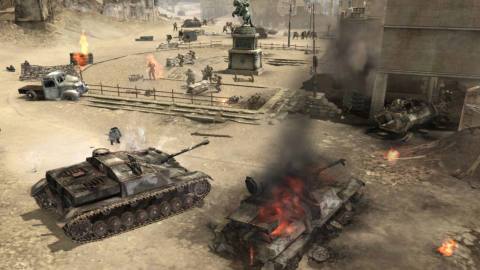
Relic describes this phenomenon that got its hooks into me as “Humanizing the Battlefield,” which they consider a core component to the franchise. In Company of Heroes, the audio and the animations, even outside of cutscenes, made me feel like these little soldiers I was ordering around were real people with lives back home they hoped to return to. They would take cover. They had morale, and could get pinned down or flee if they came under heavy fire.
Your average marine in Starcraft is basically an action figure. But when I zoomed in really close to an infantry squad in Company of Heroes, I found myself imagining: that one is Joe from Tennessee, and I could picture his cat, and the signed baseball on his dresser, and the kinds of pies his mom made for Thanksgiving. It sounds a little twee and overwrought, maybe, but they sold the illusion.
Relic was in the middle of a generational run, too, having almost completely reinvented the RTS formula a few years earlier with the original Dawn of War. After years of Warcrafts and Starcrafts and Commands and Conquers, Ages of Empires, they threw out a lot of the basic design of resource harvesting and base building and made a new breed of strategy game that was all about cover, momentum, and territory control. Another piece of why Company of Heroes felt so much more real is that its incentives led to the kinds of maneuvers and firefights a real battlefield commander might employ.
As for how they pulled this off, it may have simply been the boldness not to cut any corners.
“One of the defining characteristics of the CoH team was that nobody knew how to say no,” principal programmer Remy Saville recalled. “Every time someone had a cool idea, we’d find a way to squeeze it in. Cover systems, destructible environments, squad tactics, all of it. The result was a game absolutely packed with features because the team was constantly pushing for more.”
Apparently they really knew they had something when, Saville reminisced, people stopped taking lunch breaks just to stay at their desks and play more Company of Heroes. This same maximalist attitude, however, might have contributed to getting the team in trouble down the line. But for now, things were only looking up. Company of Heroes shipped as the highest rated RTS in PC Gamer’s history with a 96—still one of the highest scores we’ve ever given to this day. It would receive two successful expansions, with Opposing Fronts in 2007 and Tales of Valor in 2009.
Into the Cold
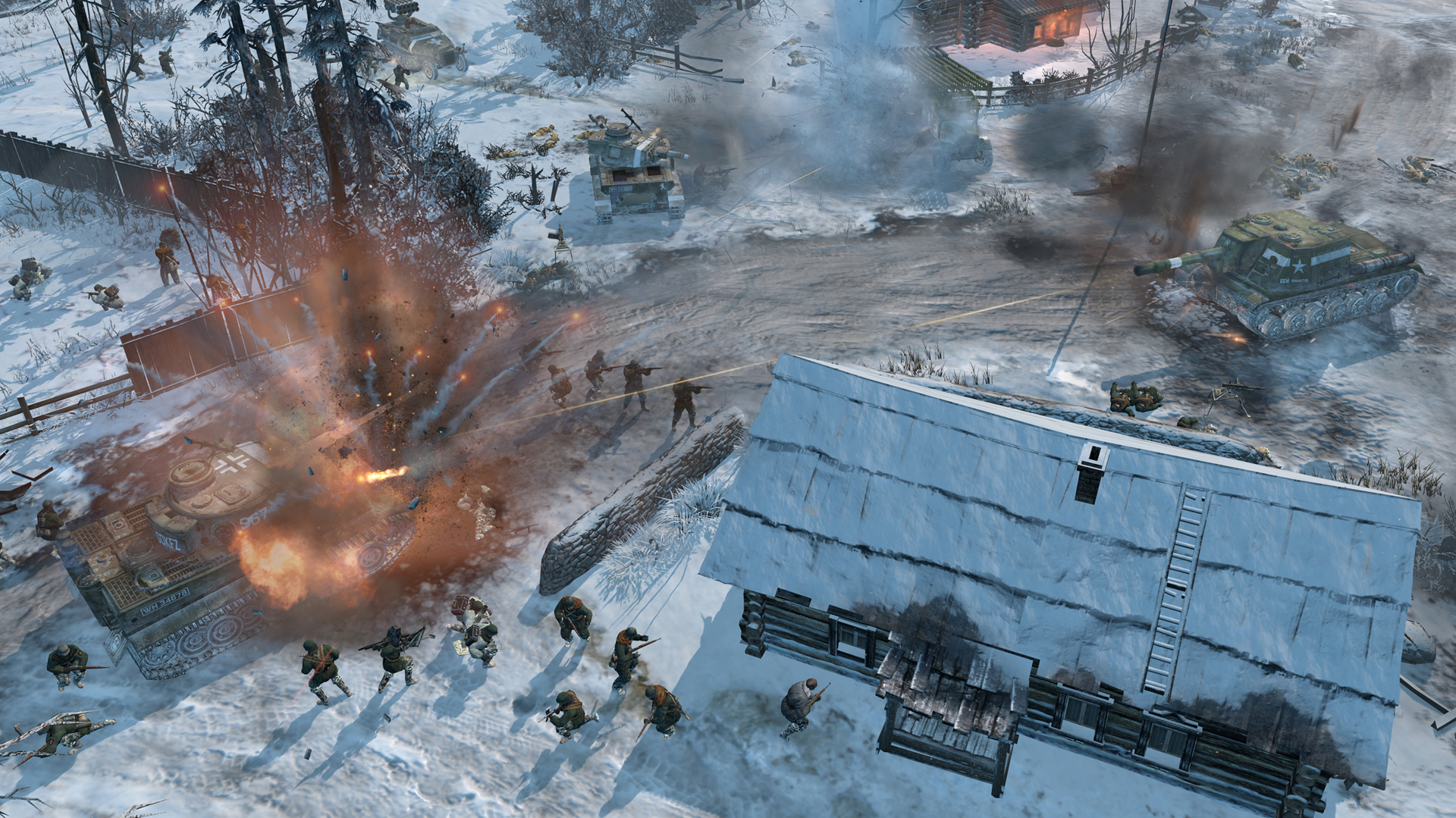
Discussions of a sequel were already in motion not long after the first game shipped. And while the first had focused mainly on the British, French, and American experiences on the Western Front, it seemed natural to head East for the next chapter. It would be a long wait for 2013’s Company of Heroes 2. Long enough that the kid from before who had been failing trigonometry had made her way out to San Francisco to be an intern at the very magazine she’d once walked to the store to snag every month.I still remember seeing the demo for CoH2 in the office for the first time, before it had even been revealed to the public. It is a very different game. And in keeping up with a bit of a pattern that started with Dawn of War 2, it became another Relic sequel that took some big, divisive swings, and I ended up enjoying even more than the original.
The Eastern Front as Relic depicted it was a warscape defined just as much by Mother Nature’s contributions as our own manufactured lead and steel. Infantry left out in the cold too long could actually suffer frostbite. Frozen lakes and rivers could be blown up with grenades, sending tanks plunging into the icy depths. I absolutely loved it. It’s still my favorite game in the series, and we might never get anything like it again. But it was not universally embraced, especially by the competitive multiplayer community.
This put Relic in a bit of an awkward spot that I’ve seen various studios have to navigate. When you release something as genuinely iconic and beloved as Company of Heroes, the follow-up can’t just be more of the same. It has to bring something new to the conversation. And inevitably, not everyone will love those new things. Where once the spirit of throwing every cool idea into one game had produced a hit, now it had resulted in a wave of backlash.
Far from being panned, however, our own Rich McCormick wrote in his review, scoring an 80, “sometimes clumsy, a game that can’t maintain all its systems, with too many disparate moving parts to feel consistently coherent. But the final result, despite the small losses along the way, is a winner.”
Still, the narrative had started to crystalize in the ice that maybe Relic had lost a little bit of that magic from the 2000s. Company of Heroes 2 was good, but not as good as the original, so you’d hear around RTS enthusiasts. And with Dawn of War 3 turning out even more disappointing a few years later, that started to become something almost like common wisdom.I wasn’t fully buying it, though. And the biggest reason was a little expansion pack released in 2014 called Ardennes Assault. Taking place on a dynamic map meant to simulate the Battle of the Bulge, it allowed you to move troops around from province to province between RTS skirmishes to cut off enemy retreats and reinforcements. I distinctly remember this as the peak of Company of Heroes as a franchise. Its voiced commanders with rich backstories, reactive campaign AI, and the way it really forced me to pick my battles wisely kept me coming back to it even years later.
Bella, Ciao
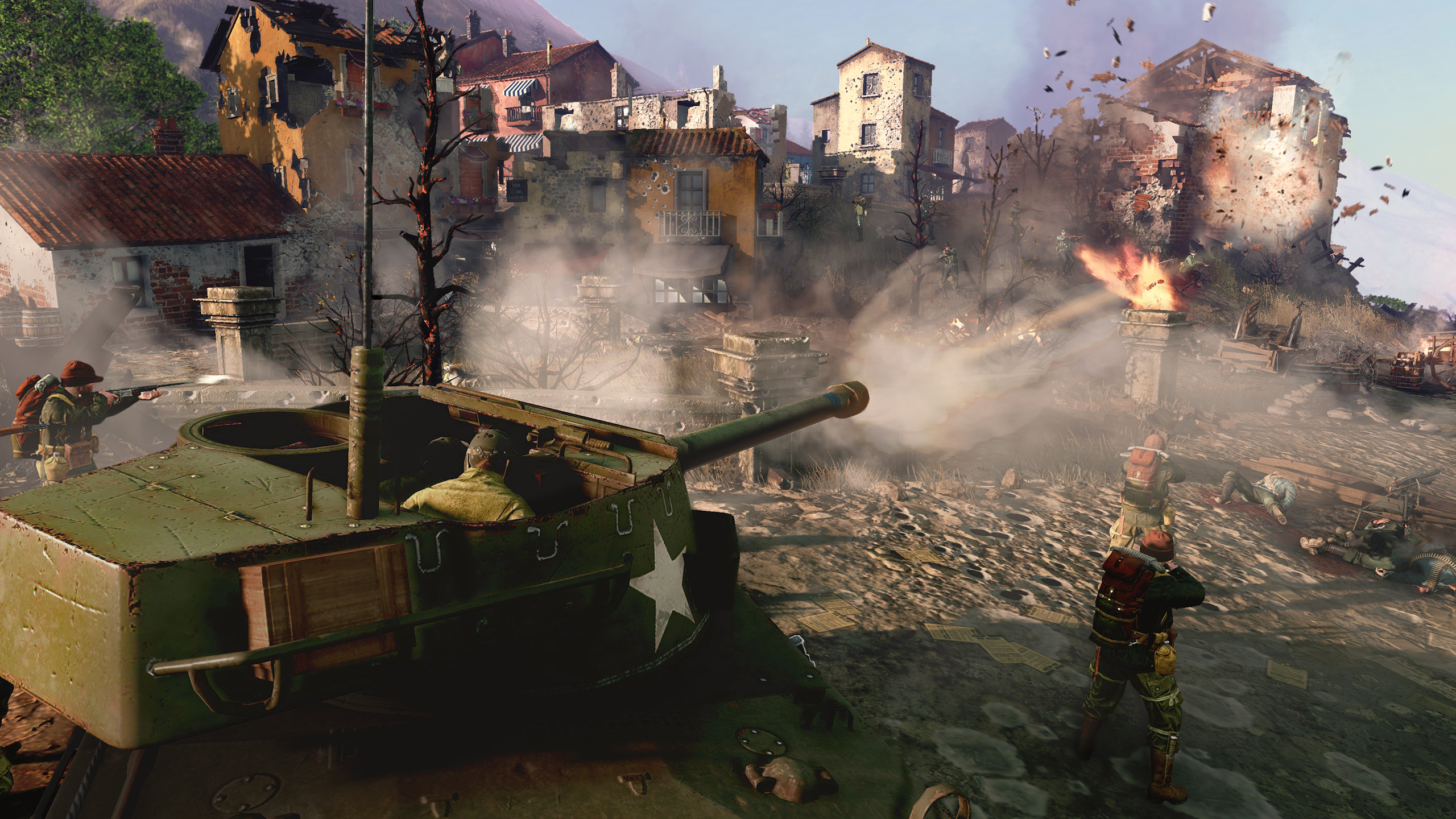
When it came time to start thinking about Company of Heroes 3, that spirit of wanting to go big hadn’t left the team at all. Looking at the positive reception to Ardennes Assault, an idea started to form of an even larger dynamic campaign set during the lesser-known liberation of Italy. At the time, Relic was working with Sega, who was also in charge of the Total War series. And from my perspective, the influence of modern Total War campaigns seemed apparent.
The problem is that it just didn’t work very well. I remember being asked what I thought of Company of Heroes 3 at launch by a colleague and saying the RTS battles were as good as they’d ever been in the series, but the Italian campaign… well, that was kind of rough. Our own Fraser Brown concluded, in what was otherwise a mostly positive review, “right now it’s impossible to look at it as anything other than a failure.”
“Yeah, we bit off more than we could chew,” Relic CEO Justin Dowdeswell told me very frankly. “The idea was great. The spirit of it was good. The team was energized. It was just more than we could get done in time, and that’s it.”
The road only got rockier in the aftermath of what ended up being a rough launch for Company of Heroes 3. The studio faced two rounds of layoffs, representing a large percentage of their overall staff, in 2023 and 2024. Many of the people I remember talking to regularly when covering Company of Heroes 3 were no longer around when I visited to discuss the current state of things. After the announcement that Dawn of War 4 was being developed by German studio King Art Games—I was later told Relic passed on it as they simply didn’t have the bandwidth to take it on alongside other ongoing projects, mostly related to Company of Heroes—I was wondering if there even would be a Relic anymore.But in the meantime, they have split from Sega and become independent again. And while a smaller team than they were at their height, what I saw in Vancouver this summer was a company of coders, artists, audio engineers, and programmers who seemed to be in high spirits. While the ordeals of the last few years would be enough to break the morale of even seasoned troops in the streets of Carentan, they all seemed to be excited about continuing to work on this franchise.And it’s still chugging along, with the recent release of the wave-based Final Stand mode last month.
Battles to Come
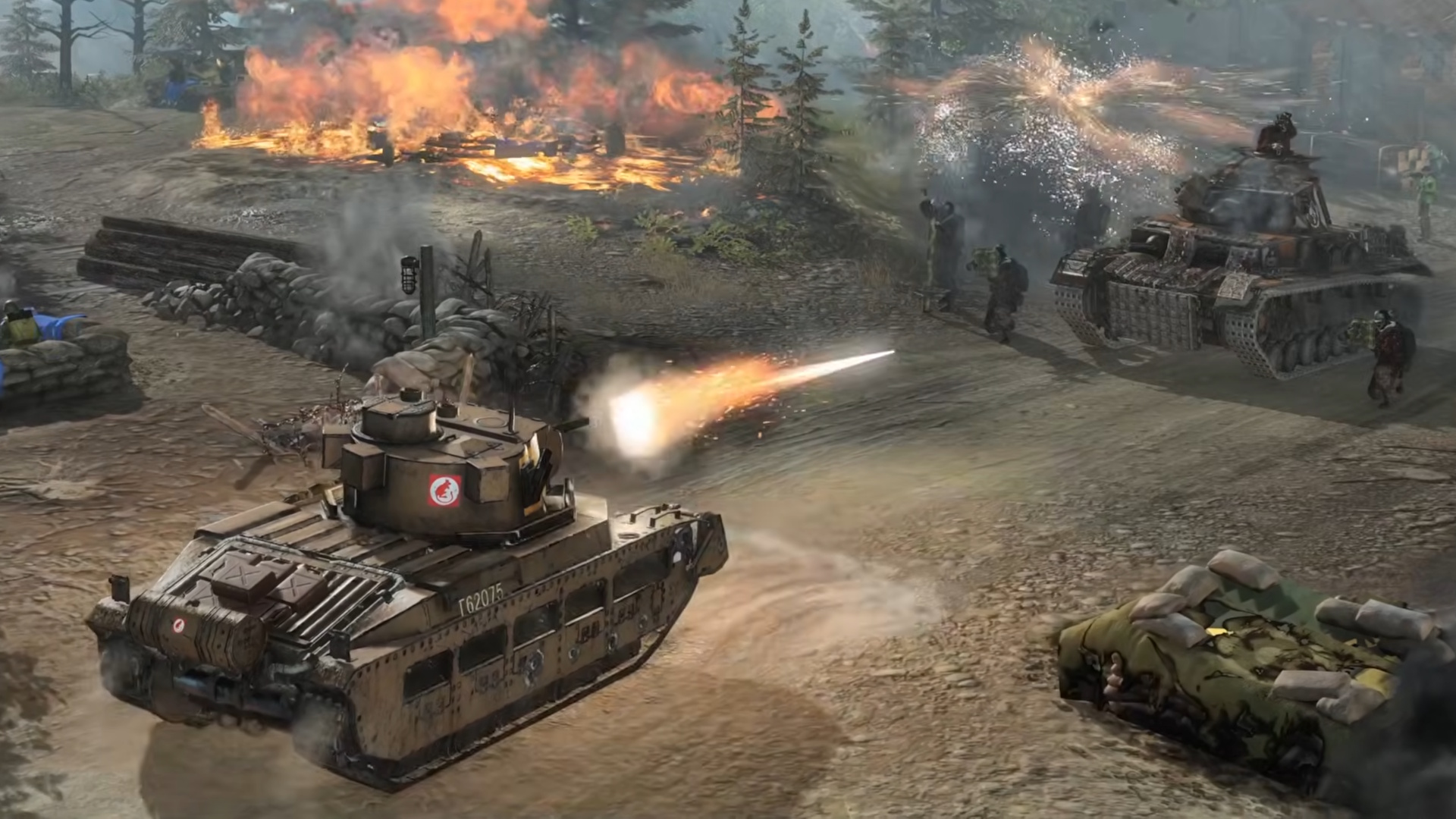
The picture isn’t exactly clear yet for what the next chapter of Company of Heroes might be called.”The last chapter was called ‘Chaos,’ I know that,” Dowdeswell quipped.
But there is a team with a drive to write it. The franchise, at the moment, might seem like it’s knee-deep in seawater, under heavy German machine gun fire, just trying to make it to that shingle, especially without a large publisher like Sega providing air support.
“We will survive and thrive based on the success of the decisions that we make along the way,” Dowdeswell said of their newfound independence. “And I think there’s been, I don’t know if it’s a cultural shift, but a mood shift at the studio once everyone really started to see that it is up to us. The things we do can make a difference for the better, and when things go well, it was us. And I think that it removes any sort of question around, well, whose fault was that? Or whose win was that? Well, it’s ours, either way, and I think that’s more empowering than difficult.”As a Company of Heroes fan, I hope to see this scrappier, independent Relic push forward to victory in spite of the setbacks they’ve faced since they first got off the landing craft 20 years ago. It won’t be easy. But the commanding officers at the front seem to have no delusions that it will be.”The industry’s in turmoil, and this wasn’t a guaranteed outcome for the studio,” Dowdeswell concluded. “So I’m really pleased that we’re here, able to support the games, and able to celebrate this 20th anniversary.”
So am I. I’ll crack a cold one to remember my boy Johnny Vastano from Ardennes Assault and send my best wishes to all the former Relic devs who I couldn’t share one with on this trip, as tumult continues to follow after just about anyone involved in making games. We’ve lost a lot already, and I’d hate to lose Company of Heroes. So it’s good to see that they’re keeping up the fight.
2026 games: All the upcoming games
Best PC games: Our all-time favorites
Free PC games: Freebie fest
Best FPS games: Finest gunplay
Best RPGs: Grand adventures
Best co-op games: Better together
About Author