
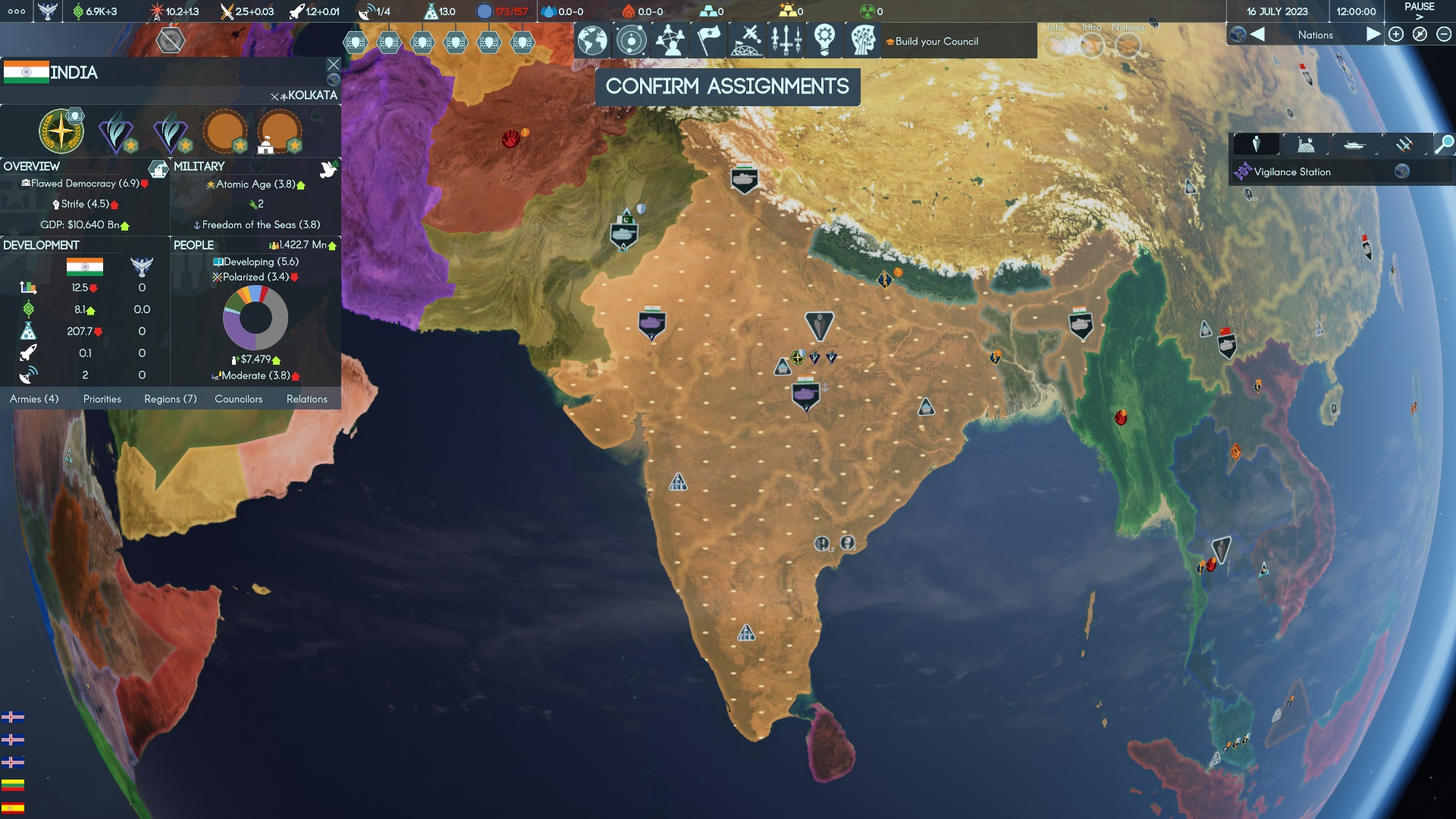
Even if you’ve only got a passing interest in strategy and management games, you’ve almost certainly encountered Hooded Horse before—it’s the publisher behind Manor Lords, Against the Storm, Endless Legend 2 and 9 Kings, to name but a few. It started in 2019, and since then it’s published a slew of successes. It’s rare that I don’t have a Hooded Horse game in rotation these days.
One of the things that makes its success so surprising—though I’m beginning to think it’s one of the core reasons it’s done so well—is that Hooded Horse CEO Tim Bender started the company with no industry experience, aside from his passion for modding.
“I did a bunch of different things, so I bounced around a lot,” Bender tells me. “I don’t think I was particularly reliable in terms of career orientation.”
He graduated from college early, went to law school at Stanford, spent a year as a lawyer, then went back to school (to Harvard this time) to do a master’s degree in Regional Studies: East Asia. A two-year-stint as a consultant at McKinsey followed, and then he was back at Harvard again, to do a PhD in ancient Chinese history.
Bender never finished his PhD, getting a terminal master’s degree instead. He then moved in with his wife, Hooded Horse president and CFO Snow Rui, and modded as a hobby. You might have encountered his Viking Conquest Balance Mod for Mount & Blade, which has been downloaded over 40,000 times on ModDB.
“I was like, I’m just gonna change 13 little numbers that bothered me, and then I just got absorbed into it,” says Bender. By version 13, the changelog had grown to 20 pages, “where I was doing things like causing Odin to come in and reward you when you did certain things in tournaments”.
The ways in which [game] publishing contracts are generally written violate a lot of principles of what’s an efficient contract.
Tim Bender
The mod was released in 2018. A year later, he was the CEO of a publisher.
One of the things that stands out about Hooded Horse is its approach to contracts, offering very favourable terms to developers. It’s where Bender’s legal background comes in handy.
“The ways in which [game] publishing contracts are generally written violate a lot of principles of what’s an efficient contract,” he says. He was taught that “there are principles involved in how contracts should be done that help everyone”. But in the videogame industry, contracts often favour the publisher at the expense of the developer.
“One of the principles is that risk should be borne by the party best able to bear that risk,” he says. So that would be the publisher, which typically has the funds and assets that allow it to weather the risk. It’s certainly not the indie studio, which has nothing aside from the game it’s trying to make.
Bender says that “it can lead to a more efficient contract for everyone”, and that it’s “not even just an altruistic thing, it’s better for everyone”. It’s better for the developer because they don’t need to wait for a publisher to get all their costs first, and it’s better for the publisher because that developer is more likely to survive, in turn making more games and money.
All the money going to the publisher first is “fundamentally stupid,” he says. “There’s a lot of games that come out, maybe they had a little bit of rough launch, but could have recovered, or maybe they had a fine launch, but it wasn’t good enough to overcome some giant recoup term where the publisher was taking all their money back first. If only that hadn’t been there, they could have been supported.”
We don’t always see this as players. A game comes out, has a rough launch, and then the support stops. The developer often gets blamed, even if it’s “buried in some recoup term”. It doesn’t have the funds to keep going because it’s not making money out of its own game. And Bender says this isn’t an efficient way to make money for the publisher, either.
“No publisher out there is making its money from recouping and dragging every last dollar out of things that underperform. Publishers make their money on the games that go well. If you don’t have these recoup terms, there’s more chances those other games go well. The developers are better incentivised, better able to create things. Everyone’s better off.”
For Hooded Horse, then, it was critical to create contracts that could lead to better results for everybody. “I guess it’s how I justify having spent three years at law school,” Bender jokes.
No publisher out there is making its money from recouping and dragging every last dollar out of things that underperform.
Tim Bender
A standard contract between Hooded Horse and a developer has no recoup, and 65% of all revenue goes to the developer. In the cases where Hooded Horse partially funds a game, its revenue share is larger, “so we make a higher percentage over time that eventually rewards the development funding investment but does not deprive the developers of cash flow,” Bender explains.
Hooded Horse used to also guarantee $100k towards marketing costs and things like localisation and other expenses, but it eventually dropped that from the contracts—but only because it typically spends more than that, and putting a specific number in there caused confusion, with devs getting worried that, for instance, $80k had already been spent on localisation, so there’d be nothing left to cover other expenses. Bender doesn’t want devs to worry about the number.
While Bender emphasises that this isn’t altruistic and “it’s actually the best thing you can selfishly do for yourself as a publisher”, it seems clear that he’s not as money-motivated as a lot of other publishers. Indeed, despite having no game development experience—aside from a producer credit on Terra Invicta, the first game that Hooded Horse hooked—Bender talks a lot more like a creative than a publisher. Or, at the very least, he protects the creatives.
“I’m not saying that I’m just secretly pretty long term about my greed,” he says. “Honestly, I do think that ethical treatment of developers and players is critical.” It’s written into Hooded Horse’s corporate bylaws. “Being a lawyer, I knew I could do this. People say ‘Oh, corporations must serve the shareholders and always generate maximum profits.’ Maybe not true, because you can define the purpose of a corporation any way you like.” A corporation built on “artistic integrity” and ethics is possible, nothing is stopping anyone from doing that. We just don’t see it happen very often.
Bender wants to improve the industry, though his arguments about ethics and artistry “sort of falls on deaf ears”. That’s why he reframes it: “It’s OK if you’re greedy, if you’re gonna be intelligent about being greedy. Think long term about being greedy. Because if you’re doing that, you end up in a much better place than most things end up, I think, and you end up treating people better, because that really is actually a pretty good way of doing business.”
In this era of late-stage capitalism, it’s a refreshing stance. And it’s one that allows Bender to pursue more than just massive profit and unrelenting growth. The driving force behind that is often shareholders, because they want a greater return on their investment. But between Bender and Rui, they own the super majority of Hooded Horse’s shares—67%—protecting the publisher.
Another reason he wants to avoid continually growing is that it would “dilute our focus”. Right now, Hooded Horse can do about 10 new commercial releases a year. “It’s partially about being able to deliver a good service to developers,” he says. It’s the same reason Hooded Horse focuses on strategy, management and a dash of RPG. “We’re good at something. We like it. We’re good for that. Other things can be done by other people who are good at that.”
Other things can be done by other people who are good at that.
Tim Bender
So Bender doesn’t want Hooded Horse to become a public company and keep growing. “My goal for Hooded Horse is to be a positive influence and a great company for 100 plus years,” he says. Not being sold, not being partitioned off, no layoffs, just “endurance and stability”.
He sees himself as “fundamentally unambitious” and just wants to “help amazing artists get their games out there”. He emphasises that Hooded Horse doesn’t create games, and its role is a service provider. Bender judges his success on how well Hooded Horse serves its developers, rather than hits.
Bender has found other ways to champion indie games, too. He’s a partner at Griffin Gaming Partners, a large gaming VC, a position he says he uses to “help indie developers and others get funding”. For instance, he got Griffin to buy Playdigious, a publisher that ports PC games to mobile, including Loop Hero, Subnautica and Don’t Starve.
What’s wild is that Playdigious’ former owner, Fragbite, sold the company to buy bitcoin.
Per Fragbite’s press release: “We now got the opportunity to divest the subsidiary in a favourable deal that allows us to secure a strong capital position, evolve Fragbite Group further and support new strategic initiatives such as the Bitcoin Treasury initiative.”
So it sold its largest subsidiary, which was responsible for 77% of total revenue in 2024, to invest in bitcoin. This is the mindset a lot of indies have to deal with. After being acquired by Griffin, Bender says, “it’s freed and enabled and supported to do what [it] does best”. Bender is now president of Playdigious, though he says “their achievements are their achievements”.

Between Griffin and Hooded Horse, Bender believes that he’s better positioned to help get indies funded and supported, directing money to “the right places”.
When it comes to the health of the industry, Bender is endearingly outspoken. Take, for instance, the glut of indie publishers that have cropped up over the years. “Most indie publishers are not people an indie developer should work with,” he says, citing issues like publishers signing a bunch of games, but only so they can find the big success and invest more in them, while ignoring, abandoning or dropping the ones that aren’t.
Most indie publishers are not people an indie developer should work with.
Tim Bender
And then there’s AI. Surely you didn’t expect a videogame article in 2026 not to touch on the incredibly obnoxious elephant in the room. A lot of well-respected studios and publishers have been disappointingly wishy-washy when it comes to their stance on the technology, like Larian, which was experimenting with gen AI and initially defended it, before the backlash prompted it to swear off using AI concept art tools, while still saying it would continue to experiment with AI across other departments.
With Hooded Horse, things are a lot more clear cut. It doesn’t want gen AI in the games it publishes. “It’s one of those things that we have a union of being aligned with our developers and with players,” says Bender. “Players don’t, by and large, want gen AI.”
He clarifies that some players might say they’re fine with gen AI, conceptually, but it’s not an abstract question. Gen AI is, as it stands right now, not fit for purpose, and it’s a threat to the artistry that goes into making games. “Like, actually look at what gen AI is. As well as the degradation of the artistic community, what would happen in the broader sense, gen AI art is not something that would be healthy for the experience of gaming.”
Earlier in the month, Bender told Kotaku “I fucking hate gen AI art” and explained how he wouldn’t publish a game with AI assets. Following that, he “got some questions” and saw people posting in forums asking how it’s even possible to enforce this. He believes that’s the wrong question.
“There is no enforcement problem with developers,” he says. People were expecting him to say he’d sue a developer to enforce it. “What kind of relationship are they envisioning here?” The no gen AI art is a contract term, and it aligns Hooded Horse and its developers. “The importance is the alignment. There is no enforcement against developers, because the developers are aligned.”

The better question is “how do we jointly do this together in a world that is constantly trying to shove it at you?” He remembers feeling frustrated in the interview because there’s a whole new world of nonsense that he and the studios he works with now have to deal with.
“Developers, who don’t want gen AI art, [they might] contract with some freelance artist or some art outsourcing firm, and they’ll be very clear. And you can still get something back, like someone did something, things slip in, or someone doesn’t follow the directions. There’s all these circumstances that make it very hard.”
How do we jointly do this together in a world that is constantly trying to shove it at you?
Tim Bender
Even outside of game dev, it’s so difficult to avoid AI. Just think about how often you encounter it. A cute video of dogs doing something funny? Might be gen AI now. Someone posting art inspired by their MMO characters in a subreddit? Yep, that might be AI too. Simply existing in the world, or at least online, means you are faced with a tidal wave of AI slop every single day. It sucks.
For Bender, AI usage at any stage isn’t acceptable. Clair Obscur is a perfect example of how just using gen AI for placeholder art is still a big risk. Sandfall forgot to remove it, it ended up in the finished game, and it cost the studio two Indie Game Awards (not that Clair Obscur needs more awards at this point).
Its prevalence, though, means Bender thinks it could still slip in. “We will fuck up. We publish lots of games, and our developers align with us, but at this point it’s in the pipelines with art outsourcing. There’s people, like some freelancer somewhere, something will have this happen. But what we can do is make a firm commitment. This is that we guard against it in every way we can, and that we will, if it’s ever discovered, remove it.”
And this goes for all uses of gen AI—art, audio, voice overs, writing. Bender doesn’t want any of it.
Beyond the ethics of AI, it’s also just a really smart play. You’ll always have gen AI defenders, but time and time again we’ve seen players push back against AI. I do think there’s hypocrisy in how uneven it is—compare the reactions towards AI use in Arc Raiders and Clair Obscur to the outcry when it appeared in Anno 117—but whatever the game is, the majority of gamers (at least among those who care either way) don’t seem to want gen AI.
Taking a hard stance against it will likely benefit Hooded Horse and its devs, though the hard work involved in guarding against it makes it far from an easy PR win.
But that feels very representative of Hooded Horse’s approach to everything, where doing the right thing, or the thing that’s healthier for the industry, trumps short-term gains and trend-chasing. Clearly it’s working well for the publisher. Not every game is going to be the astronomically successful Manor Lords, but Hooded Horse has created an enviable library of games that players always seem to vibe with, myself included.
About Author