Bored with roguelikes? You might still want to play Dicevaders, a game about perfecting dice rolls

This is how I knew Dicevaders got its claws into me: the first thing I did this morning was boot up my Steam Deck (which is next to my bed, of course), just so I could get another run in before logging on for work. This kind of compulsive behaviour hasn’t been part of my daily routine since Titanium Court back in May, and before that, Blue Prince in 2025—so Dicevaders is in good company.

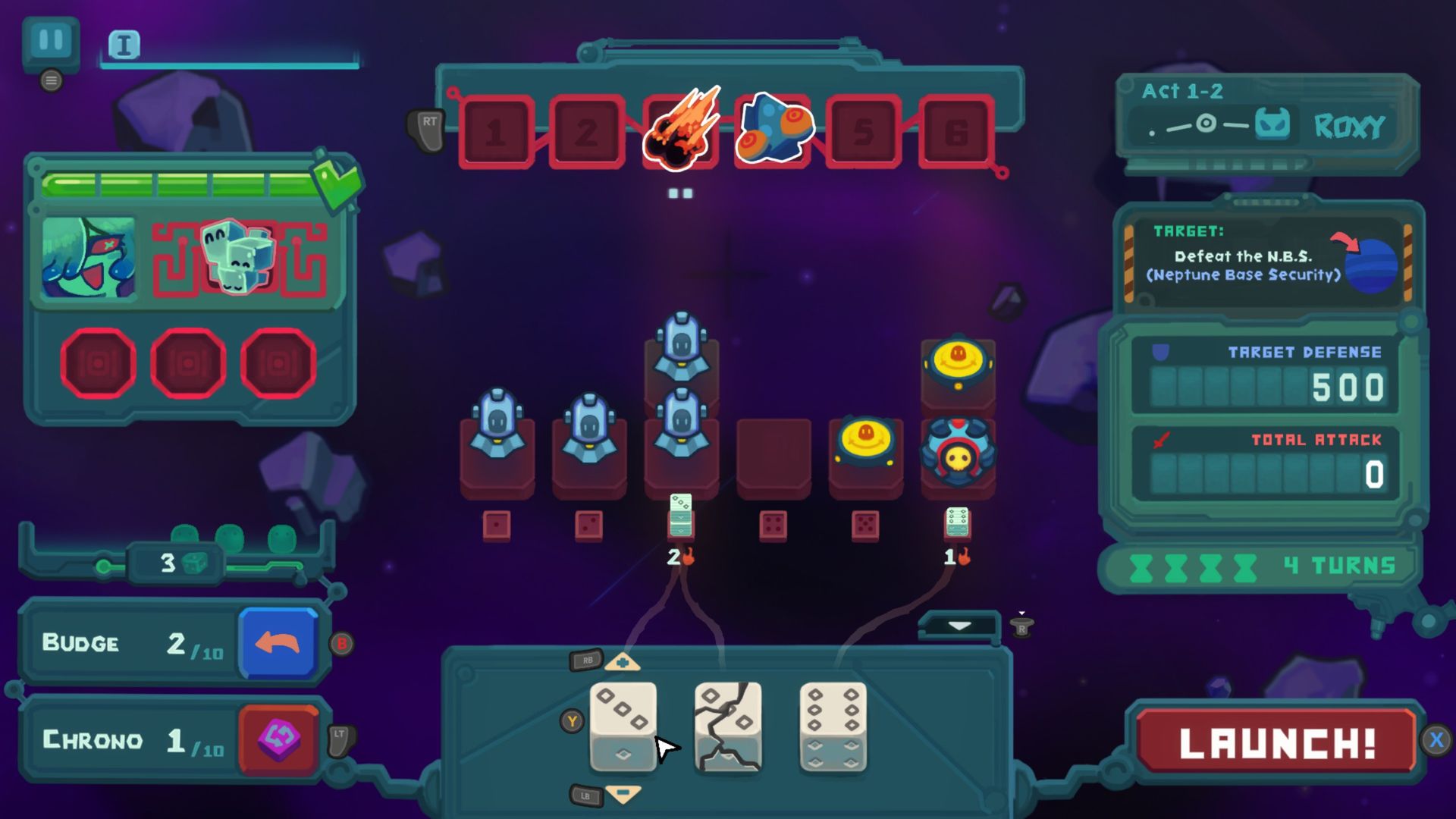
You play the captain of an alien invasion force hurtling through the stars in this roguelike deckbuilder, which is about activating units on a grid using three dice. Each column on the grid corresponds to a number on the dice. You draft your units in each column, roll the dice, then the outcome determines which columns of units will score. As you can see below:
Dicevaders screenshots

(Image credit: Playstack/Pengonauts)

Your units don’t actually go anywhere or fight anything. They each have a strength stat which forms the base score of each turn. Let’s say you roll a pair of threes and a six, as I did in the screenshot above. Your units placed in the third column will have their strength stat multiplied by two, while the unit in the sixth column will only score its basic strength stat because one dice only equals a 1x multiplier.

The goal is to hit a target damage number across four turns, which successfully triggers the invasion. If you don’t hit the number, you start losing health on each further turn until it’s game over. Of course, you can also buy a suite of artifacts which positively affect the score in many ways, from increasing multipliers to bolstering the permanent strength stats of your different units.

Written down, all of this sounds pretty familiar. And it is! But what’s key to Dicevaders’ appeal is how much scope it gives you to affect both the outcome of each dice roll and your current run. Sure, chance is a factor in how you play, yet there’s an intensive resource management layer here that makes it feel fair.

For example, you have a currency called ‘Budge’, which is self-explanatory: you can spend one Budge point to move a dice roll either up or down one per turn (so, a four becomes a five or three), and you can do this for all three dice. You can also spend another currency called ‘Chrono’ to re-roll the dice completely. That gives you quite a bit of scope to avoid the dice roll landing on the columns with all your dud units.

Both of these resources are finite. The game isn’t that stingy with them, however, and you have numerous ways to get more, which is what gives Dicevaders its feeling of fairness. In between each turn, you’re given cash to spend on units, artifacts and both these vital currencies.

You can also freeze an item to buy it on the next turn if you’re short on cash—again, all of this adds to the feeling that the developers want to give you the power to turn your luck around, rather than write off a run early.

The other resources you’re managing, of course, are your units. As well as their strength stats, most of them have specific abilities, too: teleporting around the grid between turns, attacking three times per turn but only if they’re placed on the bottom row, or randomly activating other units around the grid to add their points to the score total. There are many other variants.

Managing them is about positioning and getting their strength stats as high as possible to increase your base score. In a fun touch, you can sacrifice one unit between turns and give their strength stat to another. You’ll fatten up a unit’s strength with one of your artifacts, only to feed them to a different unit that has the special ability to attack six times if they’re played in the sixth column. Suddenly, that unit is six times more useful, and you’ve opened up another spot on the grid to drop another unit in.

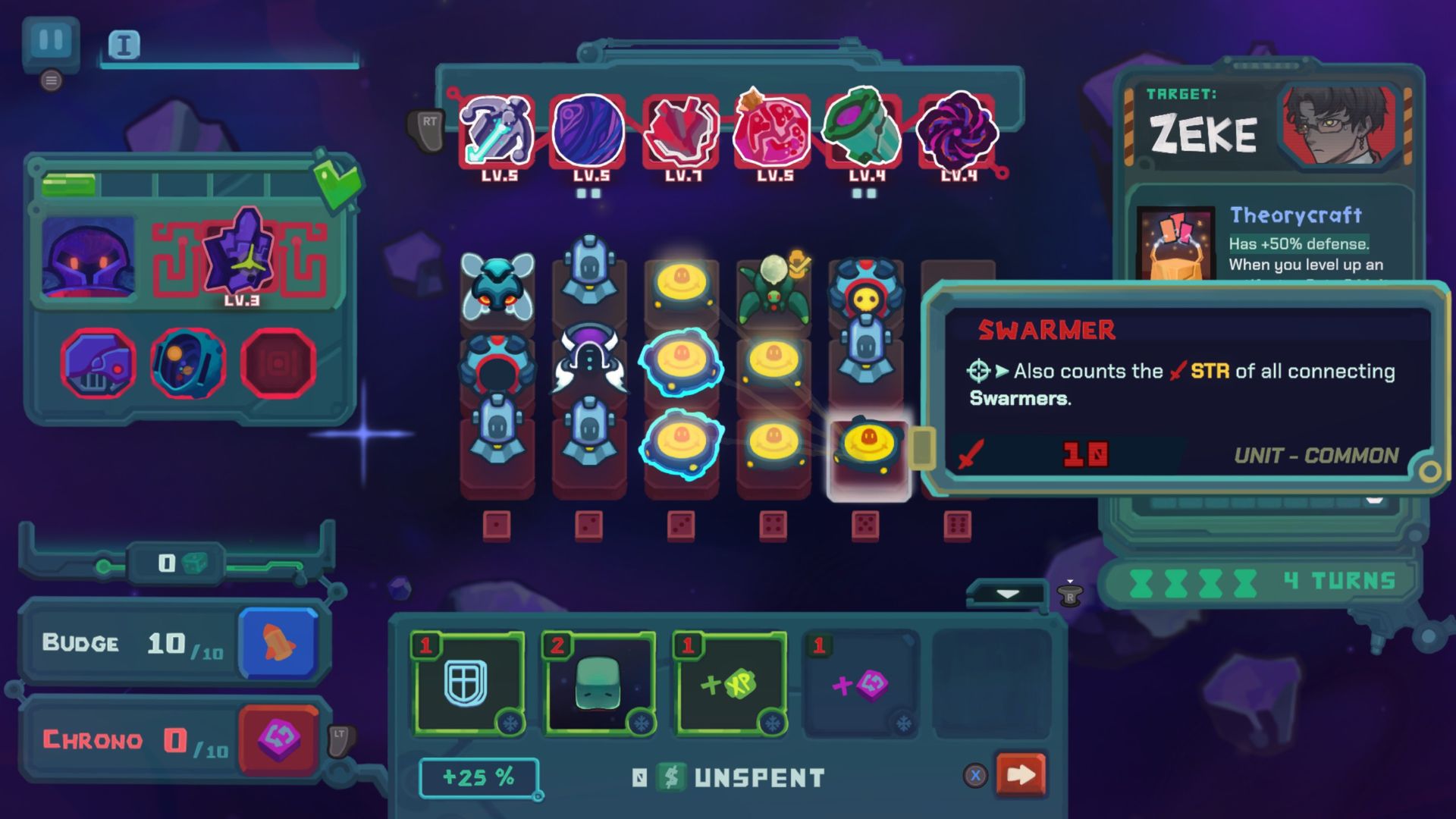
Or maybe you’ll have a network of Swarmers that share one giant strength stat with adjacent units of the same type. Which is exactly what I had going on with these yellow lads below, meaning they’d do the same base damage whether I rolled a 3, 4 or 5 in Prism Tower-like fashion.
Dicevaders screenshots

(Image credit: Playstack/Pengonauts)

“Shit yeah!” I yelled after figuring this out, before realising my artifacts weren’t scaling fast enough to keep reaching the score target. It becomes apparent that there is a staggering number of strategies you can employ to hit the high numbers in Dicevaders, and it’s excellent at teaching itself as you go.

Just by following a few simple tutorial screens, I’m punting scores into the millions already—but by no means do I feel like I totally understand the shape of the game yet. It’s hit that roguelike sweet spot.

Dicevaders seems to repackage some of the art and characters from last year’s well-regarded Starvaders, which was also a roguelike deckbuilder with more of a shooter bent. I haven’t played that, but this seems rather different—the alien invasion stuff is just a pleasantly cartoonish skin for a game about managing a grid of increasingly outrageous numbers.

I can’t honestly say that Dicevaders feels completely new and fresh, or that it’ll bust the cobwebs if you’re burned out on the hundreds of games trying to be the next Balatro. I can’t even say I fully understand why certain numbers are triggering the way they do about 20% of the time.

But it’s the real deal in terms of high-level synergies and how much control it offers you over each situation. I don’t feel like I’m pissing time into an abyss, either, which is always the risk with these games—it’s complex and has a lot of moving parts, and there are too many unit types available for you to become entirely dependent on a single strategy. It keeps you changing things up.

Now if you’ll excuse me, I’m going back to bed to play some more of it.

Source

About Author

This is how I knew Dicevaders got its claws into me: the first thing I did this morning was boot up my Steam Deck (which is next to my bed, of course), just so I could get another run in before logging on for work. This kind of compulsive behaviour hasn’t been part of my daily routine since Titanium Court back in May, and before that, Blue Prince in 2025—so Dicevaders is in good company.

You play the captain of an alien invasion force hurtling through the stars in this roguelike deckbuilder, which is about activating units on a grid using three dice. Each column on the grid corresponds to a number on the dice. You draft your units in each column, roll the dice, then the outcome determines which columns of units will score. As you can see below:

Dicevaders screenshots

(Image credit: Playstack/Pengonauts)

Your units don’t actually go anywhere or fight anything. They each have a strength stat which forms the base score of each turn. Let’s say you roll a pair of threes and a six, as I did in the screenshot above. Your units placed in the third column will have their strength stat multiplied by two, while the unit in the sixth column will only score its basic strength stat because one dice only equals a 1x multiplier.

The goal is to hit a target damage number across four turns, which successfully triggers the invasion. If you don’t hit the number, you start losing health on each further turn until it’s game over. Of course, you can also buy a suite of artifacts which positively affect the score in many ways, from increasing multipliers to bolstering the permanent strength stats of your different units.

Written down, all of this sounds pretty familiar. And it is! But what’s key to Dicevaders’ appeal is how much scope it gives you to affect both the outcome of each dice roll and your current run. Sure, chance is a factor in how you play, yet there’s an intensive resource management layer here that makes it feel fair.

For example, you have a currency called ‘Budge’, which is self-explanatory: you can spend one Budge point to move a dice roll either up or down one per turn (so, a four becomes a five or three), and you can do this for all three dice. You can also spend another currency called ‘Chrono’ to re-roll the dice completely. That gives you quite a bit of scope to avoid the dice roll landing on the columns with all your dud units.

Both of these resources are finite. The game isn’t that stingy with them, however, and you have numerous ways to get more, which is what gives Dicevaders its feeling of fairness. In between each turn, you’re given cash to spend on units, artifacts and both these vital currencies.

You can also freeze an item to buy it on the next turn if you’re short on cash—again, all of this adds to the feeling that the developers want to give you the power to turn your luck around, rather than write off a run early.

The other resources you’re managing, of course, are your units. As well as their strength stats, most of them have specific abilities, too: teleporting around the grid between turns, attacking three times per turn but only if they’re placed on the bottom row, or randomly activating other units around the grid to add their points to the score total. There are many other variants.

Managing them is about positioning and getting their strength stats as high as possible to increase your base score. In a fun touch, you can sacrifice one unit between turns and give their strength stat to another. You’ll fatten up a unit’s strength with one of your artifacts, only to feed them to a different unit that has the special ability to attack six times if they’re played in the sixth column. Suddenly, that unit is six times more useful, and you’ve opened up another spot on the grid to drop another unit in.

Or maybe you’ll have a network of Swarmers that share one giant strength stat with adjacent units of the same type. Which is exactly what I had going on with these yellow lads below, meaning they’d do the same base damage whether I rolled a 3, 4 or 5 in Prism Tower-like fashion.

Dicevaders screenshots

(Image credit: Playstack/Pengonauts)

“Shit yeah!” I yelled after figuring this out, before realising my artifacts weren’t scaling fast enough to keep reaching the score target. It becomes apparent that there is a staggering number of strategies you can employ to hit the high numbers in Dicevaders, and it’s excellent at teaching itself as you go.

Just by following a few simple tutorial screens, I’m punting scores into the millions already—but by no means do I feel like I totally understand the shape of the game yet. It’s hit that roguelike sweet spot.

Dicevaders seems to repackage some of the art and characters from last year’s well-regarded Starvaders, which was also a roguelike deckbuilder with more of a shooter bent. I haven’t played that, but this seems rather different—the alien invasion stuff is just a pleasantly cartoonish skin for a game about managing a grid of increasingly outrageous numbers.

I can’t honestly say that Dicevaders feels completely new and fresh, or that it’ll bust the cobwebs if you’re burned out on the hundreds of games trying to be the next Balatro. I can’t even say I fully understand why certain numbers are triggering the way they do about 20% of the time.

But it’s the real deal in terms of high-level synergies and how much control it offers you over each situation. I don’t feel like I’m pissing time into an abyss, either, which is always the risk with these games—it’s complex and has a lot of moving parts, and there are too many unit types available for you to become entirely dependent on a single strategy. It keeps you changing things up.

Now if you’ll excuse me, I’m going back to bed to play some more of it.

Source

About Author