The latest issue of Edge magazine includes an article on the making of Bethesda’s Fallout games, in which some of the studio’s key creatives discuss how they brought Black Isle’s classic isometric RPGs into 3D. The series was “a big pivot” for Bethesda, best known for the high fantasy of The Elder Scrolls, says lead artist Istvan Pely, who was responsible for much of the game’s look: “It started with the box art.”
One crucial element of that look was the presence of firearms, from pistols to energy blasters, which in Fallout 3 have a kind of chunky and utilitarian feel to them. “The Fallout guns are very exaggerated, they’re almost like caricatures of guns in some qualities,” says Pely. “Usually, we try to stick with vintage pre-war realistic guns. But then there’s a whole class of the more futuristic stuff, like the energy weapons.”
One of Pely’s first designs was the power armour, which turns its wearers into hulking mini-mechs, and this would also feed into how Pely thought about the weapons. “The assault rifle from Fallout 4 originally didn’t start out as an assault rifle, it was meant to be a gun that was scaled and suitable for a guy in massive power armor,” says Pely.
“In Fallout 4, our power armor scaled up. It became like mech suits that you almost drive more than wear. But because of their size, guns can be a little dinky in it. We wanted something that was big and meaty and fit the vibe. But then through the process of trying to balance things out, it became more of a generic assault rifle. In a normal person’s hands, it looks really ridiculous, a little too big, but, oh well.”
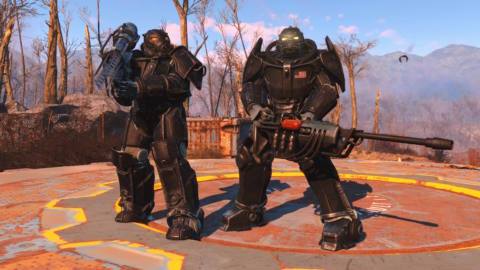
The weapons generally fit into this category of being a little bigger than they should be: not least because it looks great in VATs. “Fallout is a world of extremes,” says Pely, “and I think things tend to be a little bit pushed and exaggerated just a touch beyond what’s real, or what’s normal. I think we just kind of fell into an aesthetic of these chunky, meaty, heavy-feeling, almost slightly oversized weapons and guns. That’s more an artistic liberty to give them their own identity so they’re not just gun-guns.”
This fit with an early decision on Bethesda’s part that Fallout wasn’t aiming for realism in the elements of its world.”There is a segment of players who are really into guns, love guns and there are games like Call of Duty which are about absolute realism,” says Pely. “Fallout does not try to be that. It’s its own universe, everything evolved in a different way from real life.
“The cars are ridiculous, oversized, massive boats with little nuclear reactors in the back. Everything’s a little bit inflated, a little bit exaggerated from what’s normal. I think that’s why there’s a little bit of a sense of overkill with the weaponry, as far as, like, what it looks like.”
This even extends to a bit of visual sleight of hand depending on what the player’s wearing, which for all my hours in these games I’d never noticed. “When you’re in power armor and you’re holding a normal gun, I believe we scale it up slightly,” says Pely. “There is a little bit of distortion—you might not realize it when you see it in third person—so it doesn’t look ridiculous. We did a little bit of trickery there to try to make up for the odd shift and the slight disparity in scale.”
About Author