
I’ve thought about Fallout 4 in a lot of different ways since first playing it ten years ago. On its release, I thought it was the weakest Fallout game, lacking the roleplaying depth of its forebears. But a recent replay helped me see its strengths as a survivalist shooter. There’s a lot to love about its depiction of post-nuclear Boston if you’re willing to overlook the fact that you solve most problems with a gun.
One aspect of Fallout 4 I haven’t considered much, however, is its replayability. But it’s a point that design director Emil Pagliarulo feels strongly about, as he recently discussed. Speaking to GamesRadar, Pagliarulo explained how he believed the RPGs interweaving questlines—whereby the factions you support affect the choices available to you in the main quest—make it the most replayable Fallout game.
Pagliarulo began explaining his position by talking about Fallout 3. “The interesting thing about Fallout 3 is there are no faction quests,” Pagliarulo observed, a fact which separates Bethesda’s first stab at Fallout from its Elder Scrolls RPGs. “For Fallout 4, it was the first time we said, ‘You play Skyrim and you play these factions, but they’re disconnected from the main quest. They’re really self-contained. In Fallout 4, let’s weave everything together’. And it was the first time we did that.”
According to Pagliarulo, threading these quests together was “probably the most difficult thing” that he or Bethesda’s design team has ever done. “At one point, I gave a talk about that, and the slide for the talk is just a big bowl of spaghetti. Because that’s what it felt like, all these threads and strings that are just a mess.”
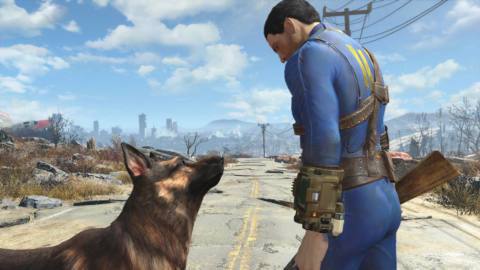
But Pagliarulo believes that the difficulty of implementing the system paid off in the end. “Doing all that work and having it stand the test of time, I think it makes Fallout 4 maybe the most replayable of all the Fallout games, which is what I love about it.”
Now, I’m sure the ears of New Vegas fans pricked up at the notion that Fallout 4 beats Obsidian’s take on Fallout in replayability. New Vegas is generally regarded as the most narratively flexible of the series, and the one that is most rewarding to return to numerous times. It certainly affords more roleplaying opportunities than 4, which is hampered by how its dialogue system forces you to inhabit a character. This is something Bethesda’s creative chief Todd Howard said “did not resonate” with players, and maybe why Bethesda reverted to a more traditional dialogue system in Starfield.
These days, I find myself increasingly questioning the supposed replayability of massive RPGs. While their various pathways may offer high replay value in theory, in practical terms seeing all those permutations requires a commitment that my spare time simply wouldn’t allow. For me, a game with high replay value is something with a shortform game-loop that I can keep coming back to in quick bursts—games like Vampire Survivors, Balatro or Sektori.
But I must reluctantly concede to likely being in the minority here. According to Steam’s recent year in review, only 14% of our collective playtime was spent on games released this year. True, that could be because everyone’s working through enormous backlogs. But I reckon it’s far more likely that players are sticking to the same number of big games. No doubt that includes Bethesda’s perennial behemoths like Skyrim and Fallout 4.

2026 games: All the upcoming games
Best PC games: Our all-time favorites
Free PC games: Freebie fest
Best FPS games: Finest gunplay
Best RPGs: Grand adventures
Best co-op games: Better together
About Author