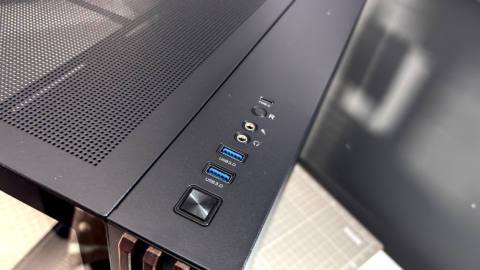
Have you ever wondered what would happen if you ate thermal paste? I’m not sure, but I can advise you that you really, really shouldn’t. YouTuber mryeester looks to have been having similar thoughts, as they’ve endeavoured to create the world’s first truly edible thermal paste—and the secret ingredient is gold.
Gold is known for being an excellent conductor of heat, and being in position of a surprising amount of 24-carat gold leaf, mryeester picked it out as the edible thermal transfer element. Yes, you can eat it, as you’ll find if you go to a very fancy restaurant. You’ll also likely find a large bill at the end of the evening, as the stuff isn’t cheap.
However, simply placing gold leaf atop a CPU heatspreader isn’t really a solution, as it ignores the reason we use thermal paste on our coolers in the first place. A traditional paste fills in the microscopic gaps of air between the chip surface and the cooling plate, improving thermal conduction considerably, which is why it’s the go-to for system builders everywhere.
So, a liquid bonding agent was required, and mryeester picked out everyone’s favorite bee-based product, honey. The other candidates were mayonnaise, ketchup, mustard, and toothpaste, if you were wondering. Yes, this is going to get messy.
Our intrepid chef then proceeded to mix the gold and honey together on top of the chip, which was a bold move given that the former is highly conductive. Still, the end result was a shiny golden blend with plenty of the 24-carat stuff glistening inside, for maximum thermal conduction.
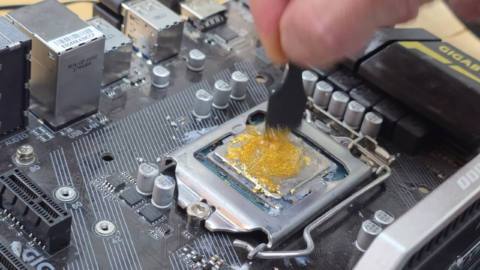
Squidging the mixture on top of a test chip with a small air cooler, mryeester recorded a surprisingly low 53 °C peak thermal figure from the un-named CPU, even at sustained 100% load.
Next up, a proper gaming PC with an AMD Ryzen 7 9850X3D inside. That’s one of the fastest gaming CPUs money can buy, and a $500 thoroughbred race horse of a chip. Gulp. Using a conventional air cooler (with conventional thermal paste), mryeester recorded a peak temp of 70 °C while playing a match of Counter Strike 2.
That’s well below the thermal limit, but what could the honey and gold mixture offer instead?
Well, less of a mess, as mryeester was quite rightly concerned about getting too much honey on their very expensive chip and motherboard CPU socket. However, the volume used was still much more than what I’d ever recommend applying to a chip with the equivalent paste. Pea-sized amounts, folks. Pea-sized amounts.
Time for a taste test. Mmm, delicious, apparently. Gold doesn’t really taste of anything, whereas honey tastes of golden fields and your imaginary childhood. Or mine, at the very least.
Large air cooler dutifully installed, a last-minute panic was averted due to the PSU switch being left off during installation. Hands up how many of us have done that? Yep, me too. Still, the PC was up and running in no time, and reported peak gaming temperatures of…. 77-78 °C.
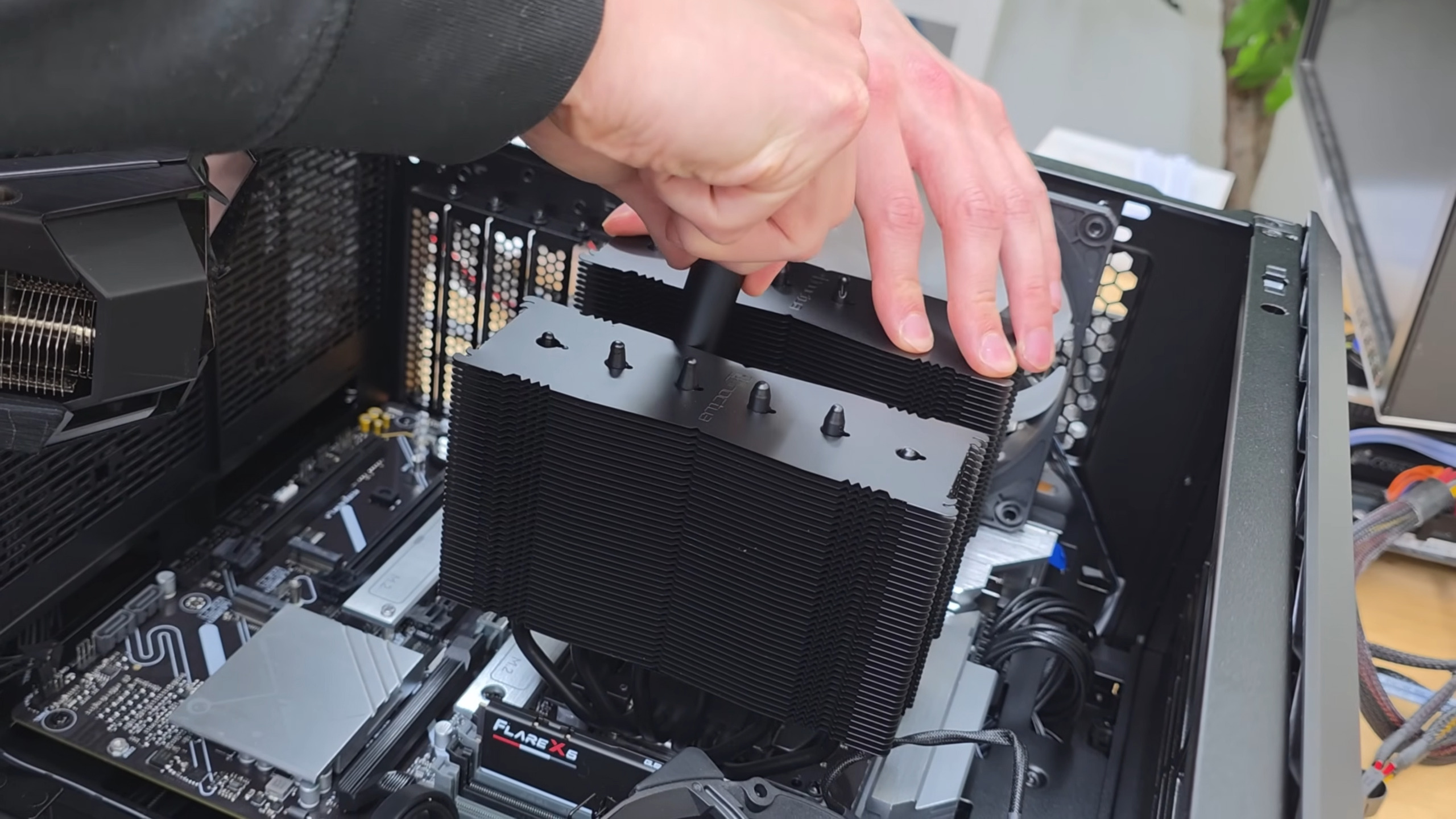
That’s a fair bit toastier than the regular thermal paste, but still well within reasonable limits for a 9850X3D. At no point did the chip thermal throttle and limit performance, although as mryeester admits, that was over a 10-minute CS 2 session.
Longer playtime (or a more CPU-demanding game) would likely lead to worse and worse results, not least because non-pure honey is a (somewhat) perishable product, and will likely change in consistency over heat cycles and time.
So, what have we learned? Well, that proper thermal paste makes a significant difference to CPU temperatures, I guess. However, it’s a genuine surprise to see that a relatively unsuitable product (even with gold’s thermally conductive properties) doesn’t appear to impair the CPU temps by all that much, and you could lick it off to clean up the mess afterwards.
Only joking. Don’t lick your PC components, folks. Actually, don’t do any of this. It’s for YouTube entertainment value and dubious science experiments only. Keep the honey for the kitchen, and do yourself a favour and spend $10 on some proper thermal paste for your next build. It’s likely a whole lot cheaper than a pack of gold leaf, anyway.
About Author