Unfortunately, the week I scheduled to write about why Deus Ex: Invisible War is good actually turned out to be the same week its creators disowned it. They admitted to being just as annoyed as years of forumites and commenters were by the loading screens, the switch to universal ammo, and the overall console sensibilities of this sequel to what was an extremely PC-ass PC game.
Which I suppose does make the part of this article where I point out that a lot of people don’t like Deus Ex: Invisible War easier to write. When even the game’s project director has been dunking on it, it’s difficult for someone to come along and say, “Well actually, everyone always loved this game and if anything it’s been over-rated.”
It’s time for those of us who always thought Invisible War was over-hated to come together and put some bandages on these re-opened wounds. Yes, the small zones separated by frequent, long loading screens were annoying. And while universal ammo never bothered me, I did wish they’d kept the option to lean around corners, which I can only assume was dropped to simplify the controls for the sake of Xbox players. But let’s not turn Invisible War into an irredeemable disaster by ignoring its strengths in a rush to highlight its flaws.
Deus Ex: Invisible War is a game about factional conflict that lets you decide which faction to support, then flip back and forth like an indecisive acrobat. The RPG thing of letting you accept an assassination mission, then show up at the target’s house, explain the situation and say, “Make me a better offer?” That’s here, but the philosophy behind that kind of freedom-of-choice stretches even further, to a degree that’s still uncommon today.
Invisible War is constantly providing opportunities to betray and obfuscate. When you’re offered missions, you almost never say yes or no outright. Instead of declaring your allegiance then and there, each mission is a possibility you can follow through on, or not, as the spirit moves you.
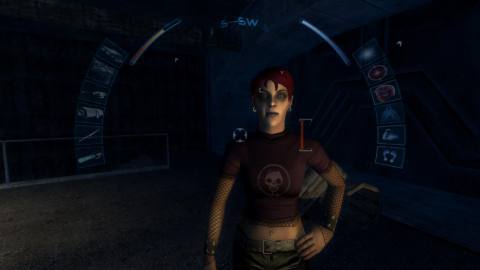
This is true on the macro level, where Invisible War is a game about conflict between the WTO’s surveillance state and the Order’s unified global religious cult. But it’s also true on the smaller scale, where you’re navigating the loyalties of individual nightclub owners and arms dealers, who are just as likely to find your cybernetic augmentations and moral flexibility to be valuable assets.
Some of the side objectives you find in Invisible War’s cyberpunk-future hubs seem trivial, like the ongoing dispute between two rival coffee chains. Pequod’s Coffee and Queequeg’s Coffee (both named after characters from Moby-Dick, just like Starbuck’s) want your help taking down the other, which can lead to industrial sabotage and straight-up firebombing.
One coffee chain markets its product with blue-collar folksiness, while the other is more middle-class and exclusive, and the managers have bought into the idea that their product is their identity. These people, who care deeply about what their brand of caffeinated beverage says about their personality, are just as desperate to take down their rivals as the people trying to reshape the world. The parallels between the conflict over who controls the government and who controls the coffee become more blatant as the game goes on.
Invisible War also lets you work for NG Resonance, an AI based on a popstar who licensed her likeness for what seems to just be a holographic chatbot for nightclubs. Her fans line up to treat her like their bestest friend, asking for relationship advice and passing on messages the AI insists will definitely find their way to the real NG Resonance.
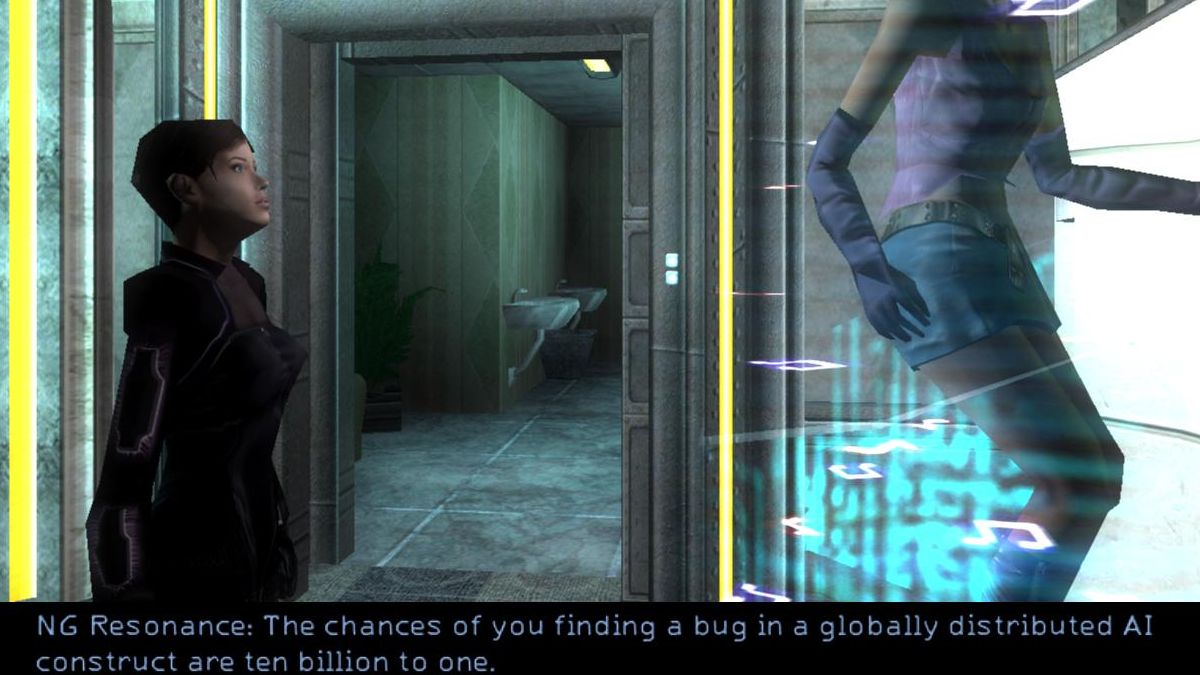
When you approach the frugging lightshow, she twigs that you’re not another fan. So NG recruits you to help with her real purpose: intelligence-gathering. Whether it’s the personal details her fans give up willingly or the shady sides of the businesses who install her as carelessly as they would a jukebox, whatever entertainment she provides is a sideline to the real business of harvesting user data with maximum efficiency. Extrapolating a correlation with current events is left as an exercise for the reader.
Played today, with the Visible Upgrade mod to speed up the load times, improve performance, and add support for higher resolutions, Invisible War is more enjoyable than its reputation would suggest. It’s properly cyberpunk, with missions full of intrigue and impersonation, and plenty of opportunities for immersive-sim ventcrawling and cybernetically enhanced stealth, soundtracked by atmospheric music. Even the main menu theme is an absolute tune. Give Invisible War a chance, and you’ll have a better time than even its own creators did.
About Author