“Out of all the games I’ve ever worked on, Godzone 6 does provide the most choices about how you achieve things,” says Jonathan Chey. It’s quite a statement from a man who’s worked on System Shock 2, BioShock, and two entries in the Thief series—all games predicated on the idea that players can make decisions for themselves, about where to go and how to overcome the challenges they encounter along the way. But from the little I’ve seen of Godzone 6, I think he may be right.
Chey was Irrational Games’ co-founder, alongside Rob Fermier and Ken Levine, but to focus solely on his work there would be a tad reductive at this point. For the length of my career as a journalist, Chey has led one of my favourite indie studios, Blue Manchu, specialising in first-person roguelikes that draw on the flavour of classic Looking Glass like a delicious soup stock. The Manchu crew’s biggest hit to date is Void Bastards, which tastes like System Shock sprinkled with shredded back issues of 2000AD.
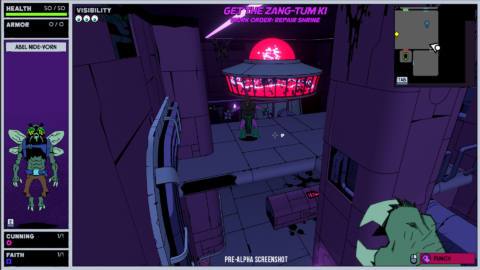
The more recent Wild Bastards was similarly excellent—a space cowboy roguelike with a layer of XCOM-esque strategy. But it wasn’t quite the sequel its title implied, and only sold half as well as its predecessor.
“Some people, I think, were disappointed because they played Void Bastards, enjoyed it and wanted more,” Chey says. “We gave this game another name with Bastards in the title. And it was another roguelike first-person shooter, and it had a strategy map. So they, I think very naturally and rightly, thought it was going to scratch the same itch. And in some sense, I think it did. But the tone and the genre did shift.”
The first-person segments of Wild Bastards were more straightforwardly focused on action; there were fewer drawers to loot and buttons to push than in Void Bastards. “It pushed that stuff up to the turn-based strategy map,” Chey says. “Overall, I think it was just as deep a game, if not deeper. But it struck some people as dumbed down. Or just more superficial and less interesting, for people who like that genre of immersive first-person games and don’t get very many of them.”
That’s how Blue Manchu arrived at Godzone 6, an unapologetically deep and complex imsim. It’s another roguelike, but this time, at the beginning of each run, you build the most disgusting and unusual mutant you can think of. Then you steer said mutant through a series of small, atmospheric, procedurally generated levels filled with granular details.
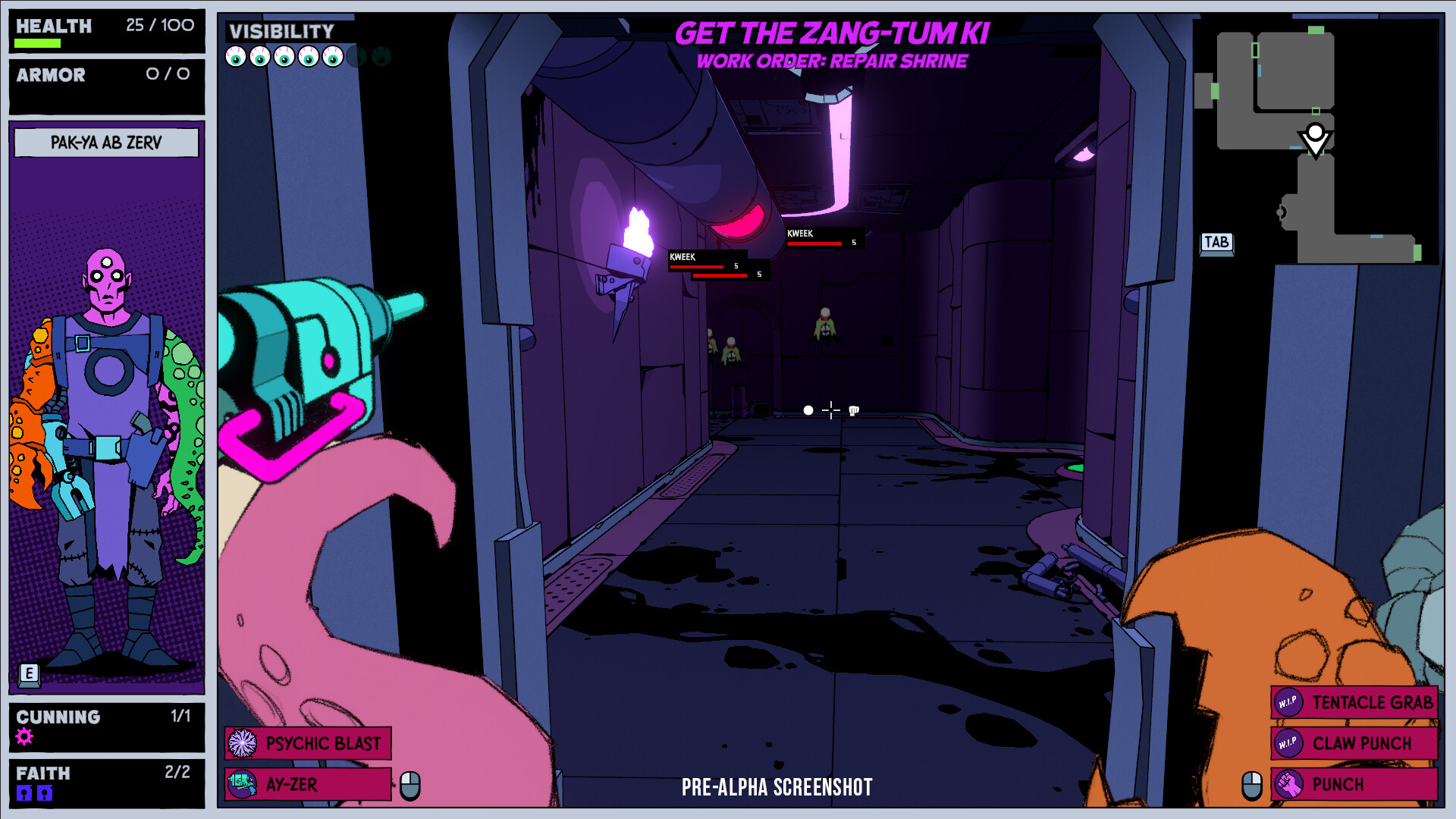
“People have made games like this—roguelike shooters where you get lots of different upgrades, and you can build different kinds of guns and stuff, and that’s really great,” Chey says. “But we wanted to have more variety than that. So it’s not just, what kind of gun am I going to build, but am I going to build a gun at all? You could be a hacker instead, or a stealth character, or essentially a magic spellcaster. Or you could be a character that runs computer programs, or is tiny and goes into little spaces that other characters can’t. Or you’re a giant or a flying character.”
So it’s not just, what kind of gun am I going to build, but am I going to build a gun at all?
Jonathan Chey
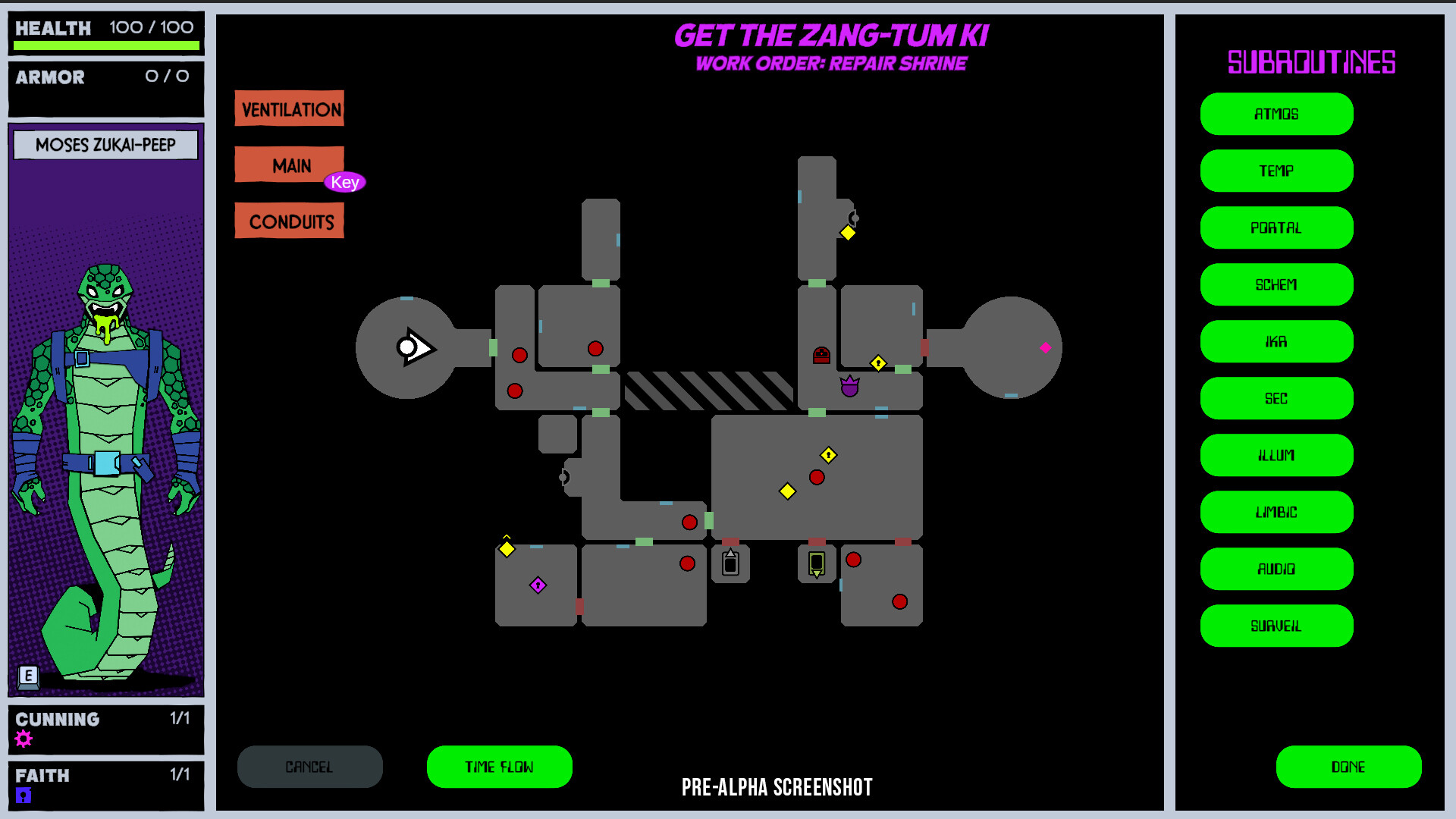
Chey boots up a run as a snakeman—a little reminiscent of Hopalong, the lasso-wielding cowpoke in Wild Bastards. Only here, by moving low to the ground, the snakeman can slide through gaps that other mutants can’t—perhaps to access a new area or escape a fight gone sideways.
“The idea is that the immersive sim creates this huge possibility space, and then the randomised formula lets you navigate through that in interesting ways,” Chey says. “So that you get to experience all of it, rather than just playing spell-casting characters every time and never seeing the rest of the possibility space.”
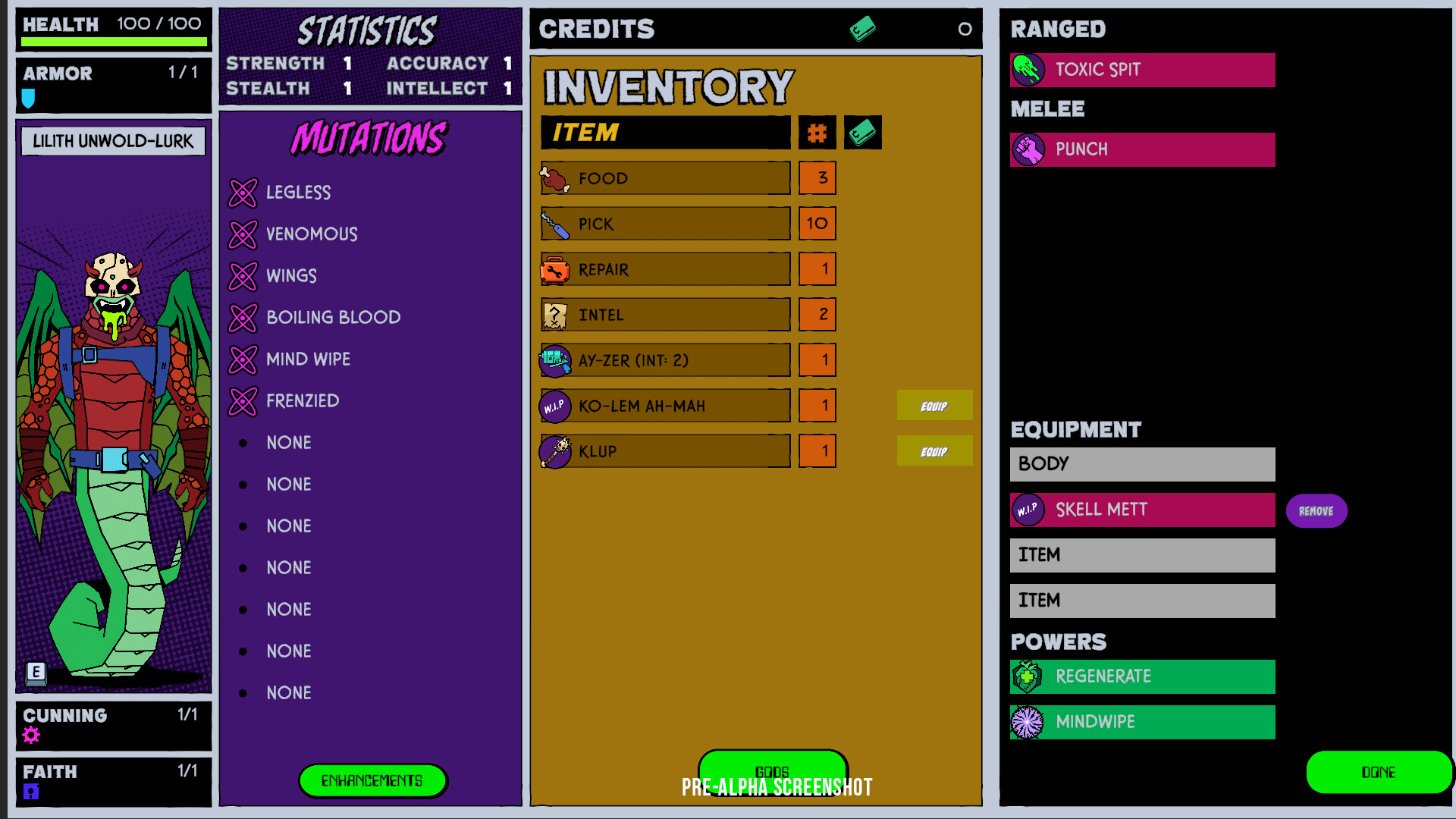
In this sense, Godzone 6 is inspired by deckbuilders like Slay the Spire—which push you toward creative solutions by refusing to reliably hand you comfortable and familiar tools. “You build these characters who have an enormous amount of variability through mutations, but you don’t have complete control over that,” Chey says. “Every time through, you might only be offered some mutations and not others. You have to figure out how to use what you’ve got.”
That might mean relying on your organic abilities, like spitting venom or flapping your wings to reach high places. Or it could mean developing your intelligence, in the hope of discovering high-tech weapons during your run. “Growing your intellect is a dangerous path,” Chey warns. “Because if you don’t find any of these relics, you wasted your spend on intellect. But on the other hand, if you don’t start becoming more intelligent early in the game, you might end up in a position where you find some really cool thing and you’re not smart enough to figure out how to use it.”
If you come across a piece of tech you simply don’t understand, you’ll at least know you’re not alone. All the mutants in Blue Manchu’s mysterious setting serve at the pleasure of the gods—which are computer systems beyond the ken of anybody living in this “crazy sci-fi dungeon”.
“Thematically, it’s a game about people living in a world that they don’t understand, but not necessarily even understanding that they don’t understand it,” Chey says. “I think that’s quite apparent in the game.” It’s an idea, he suggests, that might apply to all of us. “This game is not a critique of religion, but it becomes apparent that religion isn’t necessarily going to provide very reliable answers about how this world functions to the people who live in it.”
It’s a game about people living in a world that they don’t understand, but not necessarily even understanding that they don’t understand it.
Jonathan Chey
One experimental feature of Godzone 6, which has been a point of contention on the Blue Manchu team, is the language your opponents speak—a kind of pidgin English invented for the game. “Enemies yelling things out is obviously a big part of Looking Glass games and immersive sims, because they tell you what they’re thinking,” Chey says. “But you can’t necessarily understand that in this game, at least when you start playing.”
Over time, with effort, you might begin to make sense of your enemies’ calls and the graffiti scribbled on the walls, and benefit from that new understanding. Though Chey doesn’t expect that most players will bother. “They’ll just ignore it, and it’s fine, because you don’t really need to know it,” he says. “But it also provides a layer of exploration and discovery that I hope is interesting.”
This dense sci-fi is the culmination of many years of professional development for Chey personally. “When I was working at Irrational Games, Ken took care of all the fiction, so I didn’t have to worry about that,” he says. “But it’s a role I’m being forced to grow into, and I have committed very strongly to thinking about this world and building it. It’s a much more fully developed world than we’ve done in the past two games.”
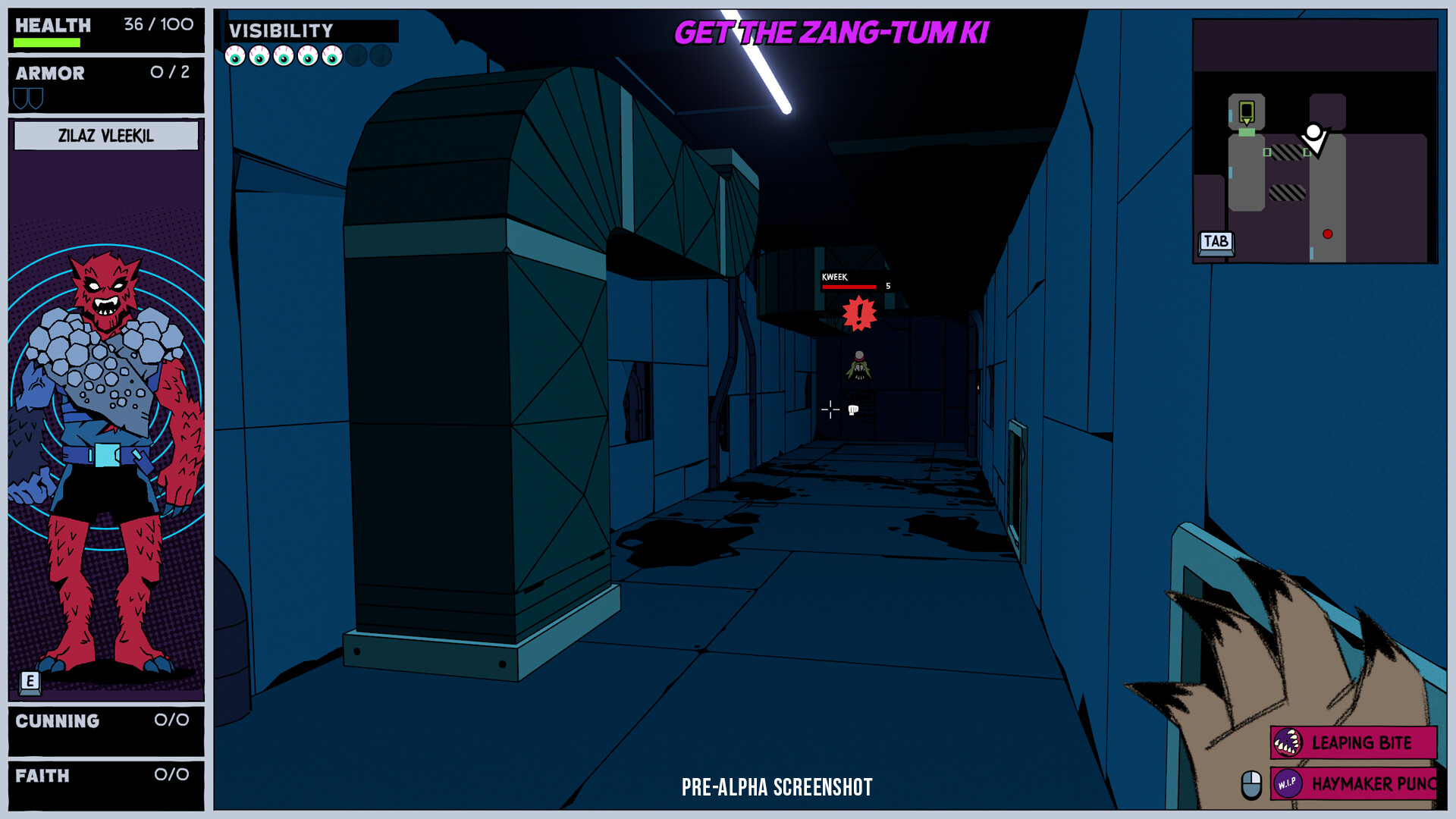
Although Blue Manchu is still prototyping, the plan is to open up Godzone 6 to the community early, via demos, preview builds and beta testing. “With Wild Bastards I think we just lost contact,” Chey says. “We handed it all off to the publisher and didn’t really talk to the audience anymore. I think that was really bad.”
Mind you, if Chey had a choice, he would sit at his desk developing all day, rather than interacting with game communities. “I wouldn’t log onto Discord and chat to people,” he says. “I actually really hate releasing games, because obviously it’s nice when people like stuff, but there are always people who are disappointed or upset. It’s very hard. I wish I never had to release a game. If I could just sit here and work on them, that would be the ideal world.”
In the end, though, it’s for both Chey’s benefit and ours that Godzone 6 will come out. “I think it’s probably good to get out and understand that ultimately, whatever you’re doing, it’s intended for consumption by other people,” he says. “If it’s just for your own amusement, it’s probably pretty easy to disappear up your own arse.”
2026 games: All the upcoming games
Best PC games: Our all-time favorites
Free PC games: Freebie fest
Best FPS games: Finest gunplay
Best RPGs: Grand adventures
Best co-op games: Better together
About Author