
Earlier this month, Intel teamed up with Elon Musk to “help refactor silicon fab technology” for Musk’s ambitious Terafab project. Now, in a Tesla earnings call, the tech mogul has said he will use the company’s upcoming 14A node to make chips for this project.
Terafab is Musk’s (one might say) bold venture into making his own chips for xAI, Tesla, and SpaceX to power cars, robots, and data centres in space. It’s apparently necessary, given the world seemingly doesn’t produce enough chips for these companies’ needs. Which isn’t as absurd as it might sound, to be honest, as CPUs are reportedly already feeling a shortage squeeze.
There’s been hope that one solution to this shortage might be Intel 18A, the process that the previous Intel CEO Pat Gelsinger said he’d “bet the whole company on.” We have 18A chips already on the market in the form of Panther Lake mobile processors, and later this year, we’ll be seeing them again in Nova Lake for desktop PCs.
14A, on the other hand, is still a couple of years out. Previously, Intel had said that it’s not in any hurry to get the process node into full swing “until we know that we have the customers that will accept that demand.” Well, how’s Tesla as a first customer for you? That should be enough to get the ball rolling, if Musk’s Terafab goals are anything to go by.
When he reported on Intel’s partnering up with Musk, our Nick hinted that Intel’s Lip-Bu Tan would most likely have had foundry and packaging wrapped up in part of that agreement, and this has turned out to be true. That’s because Intel didn’t exactly have the largest list of external customers for its foundries.
Recently, however, Intel has opened the door to having external customers for 18A, and now with Musk on board for Terafab, we have a first customer penned in for 14A.
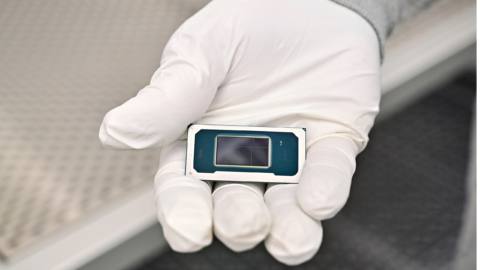
Musk expresses some optimism towards the timing of the process:
“We plan to use Intel’s 14A process, which is state-of-the-art and in fact not yet totally complete. But given that by the time Terafab scales up, 14A will be probably fairly mature or ready for prime time. 14A seems like the right move. And we have a great relationship with Intel. A lot of respect for the CEO, the CTO, and the new team there. So we think it’s going to be a great partnership.”
All good news for Intel, then, and presumably for its shareholders too. The company’s market cap is now higher than it’s been in over 25 years, thanks largely to the Terafab deal plus a multi-year deal with Google.
It all makes a refreshing change from the previous few years of stagnation and seeming issue after issue for Intel. And speaking of refreshes, the latest Arrow Lake Core Ultra 200-S ‘Plus’ refresh is pretty great, too. Hopefully, things continue in that direction; lord knows the PC hardware market needs as many wins as it can get right now.
About Author